
Fluval E Series Heater Review
Our Fluval E300 heater review covers its 100-gallon rating, color-coded display, error codes, setup, the listing's voltage question, and the E series sizes.
 Updated October 24, 2026

The Fluval E300 is the largest of the four heaters in Fluval’s E series manual: a 300-watt submersible heater with a digital display that Fluval rates for aquariums up to 100 US gallons (375 liters). If you are shopping for a Fluval heater for a 65- to 100-gallon freshwater or saltwater tank and want to read the water temperature on the heater itself, it is the E series model to look at. Before you buy, know that the Amazon listing’s voltage field shows 230 V, which conflicts with Amazon.com selling it in the US; we explain what to check below.
We did not run this heater ourselves. This review covers one model only, the E300 (model A774), and draws on its Amazon listing and Fluval’s E Series heater instructions for use, which cover the E50, E100, E200, and E300. Fluval’s own web pages for the other E series sizes were not available to us, so the E50, E100, and E200 appear here only as far as that manual describes them. Figures marked “per the listing” come from Amazon; figures marked “per the manual” come from the Fluval document.
This review is general product information, not repair or electrical safety advice. Follow the safety instructions in your product’s manual, supervise children, and contact the manufacturer or an authorized service center if a product sparks, overheats, or has a damaged cord.

We earn a commission from qualifying purchases made through links on this page. Commissions never affect our rankings or AquariumTech Scores.
Fluval E300 Electronic Aquarium Heater








As an Amazon Associate we earn from qualifying purchases.
Who the Fluval E300 Suits
- Tanks between the E200 and 100 gallons: per the manual, the E200 covers tanks up to 65 US gallons and the E300 covers tanks up to 100, so the E300 is the E series pick for a 75-gallon or 90-gallon tank.
- Freshwater or saltwater setups: the manual marks the E series for fresh and saltwater aquariums.
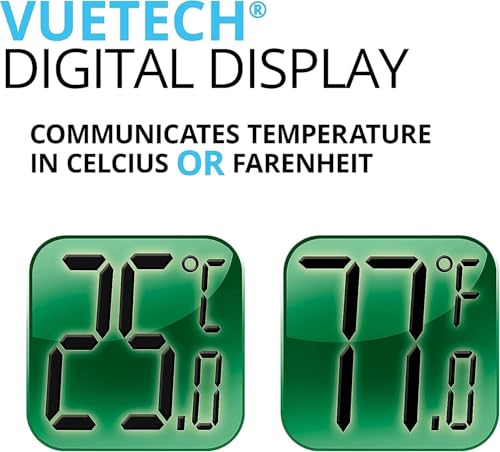
- Owners who want the temperature in view: the listing and manual both describe a display that shows the water temperature continuously and changes color when it drifts from the set point.
- Tanks with good water movement near the back glass: the manual says to place the heater at the rear of the tank close to a filter or pump outlet.
Fluval E300 at a Glance
| Spec | Fluval E300 | Source |
|---|---|---|
| Heat output | 300 watts | Listing |
| Rated aquarium size | Up to 100 US gallons (375 L) | Manual (listing: 375 liters) |
| Model number | A774 | Listing and manual |
| Voltage | The listing shows 230 volts, which conflicts with US sale (check the label) | Listing |
| Temperature adjustment | 0.5-degree steps | Listing and manual |
| Factory setting | 77°F (25°C) | Manual |
| Sensors | Dual temperature sensors | Listing and manual |
| Mounting | Suction cup bracket, side mounting adapter | Manual |
| Maximum immersion depth | 39 inches (100 cm) | Manual |
| Water type | Fresh and saltwater | Manual |
| Weight | 0.37 kg (about 0.8 pound) | Listing |
| Warranty | 5 years | Listing and manual |
Check the Voltage Before You Plug It In
The listing’s voltage field shows 230 V, which conflicts with Amazon.com selling it in the US; check the rating label before plugging it in. The Fluval manual we read does not print a voltage at all. It does say the heater is factory set to the Celsius scale for 50 Hz markets and the Fahrenheit scale for 60 Hz markets, which is another way to confirm what you received. Because of the conflicting voltage field, we lowered its AquariumTech Score by an editorial adjustment, as described on our How We Review page.
When the heater arrives, read the electrical rating printed on the heater and its box. If it does not match your outlets, do not plug it in; return it to the seller or contact Fluval’s US customer service, which the manual lists. Read the manual’s safety instructions in full before installation, including its electric shock warnings and its instruction to arrange a drip loop in the cord.
How the Display and Sensors Work
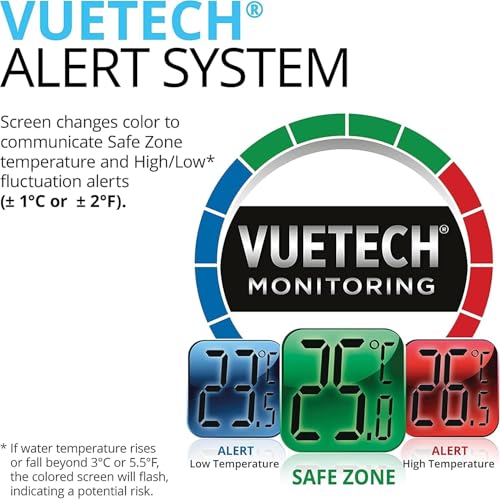
The listing describes an “intelligent digital microprocessor monitoring system with dual temperature sensors” that monitors and displays water temperature in real time. The manual explains what the display colors mean:
- Green: the water is within 2°F (1°C) of the set temperature.
- Red: the water is more than 2°F (1°C) above the set temperature.
- Blue: the water is more than 2°F (1°C) below the set temperature.
- Flashing: the water has moved more than 5.5°F (3°C) from the set temperature.
Per the manual, the internal thermal sensor reads the water temperature through the glass of the heater tube rather than the air inside the tube, and the heater has no bi-metallic contacts, so there are no moving thermostat parts. The manual also notes that if the room is warmer than the set temperature by 2°F (1°C) or more, or another heat source warms the tank, the display stays red until conditions change. So a red display on a warm day reflects room conditions; the manual does not list it as an error. If the display stays red while the room is cool, or the tank keeps getting warmer, unplug the heater and contact Fluval.
What We Like
- Temperature readout on the heater: you can see the water temperature and whether it is on target without a separate gauge, per the listing and manual.
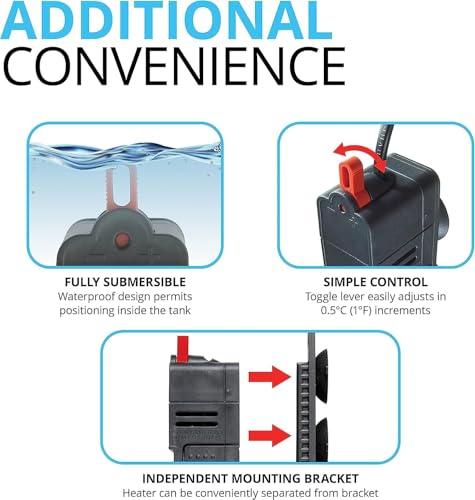
- Fine adjustment: the temperature changes in 0.5-degree steps with a lever on top of the heater, per the manual.
- Built-in error messages: the manual lists two codes, one for an abnormal usage condition and one for low water flow, covered below.
- Integrated guard: the listing describes an integrated fish guard, and the manual says the heater must never run without it.
- Five-year warranty: the listing and manual both state a five-year guarantee against defects in material or workmanship, with repair or replacement at the maker’s discretion when the complete heater is returned with proof of purchase.
What Could Be Better
- Voltage on the listing is unclear: see the section above; you have to check the label yourself.
- Glass core: the manual warns that the heater core is glass and asks you to check the tube for fractures before installing it.
- Needs water flow to work well: without good circulation around it, the heater shows a low flow code, per the manual.
- Slow, careful handling: the manual calls for 20 minutes in the water before plugging in, a self-check of several minutes at each power-on, and 30 minutes of cooling after unplugging before you lift it out.
- Cord cannot be replaced: per the manual, a damaged cord means the heater should be discarded.
Installing the Fluval E Series Heater
The manual’s installation steps are short, and most of them are about placement:
- Placement: mount the heater at the rear of the tank near a filter or pump outlet, with free water flow around it and no rocks, decorations, or gravel touching it.
- Water level: keep the water above the MIN mark on the heater guard at all times, and top up for evaporation. Do not submerge it deeper than 39 inches.
- Mounting: press the suction cups onto the glass; if the back glass will not work, move the suction cups to the side mounting adapter. You can slide the heater up or down the bracket by squeezing the two release arms on the guard.
- Acclimation: leave the heater in the water for 20 minutes before plugging it in, and arrange a drip loop in the cord.
- Setting: push the lever left or right to show the set temperature, then push again to change it in 0.5-degree steps. To switch between Fahrenheit and Celsius, hold the lever fully left for at least five seconds.
The manual also recommends filling the tank with water close to the temperature you want, and it says the heater is for indoor aquarium use only, not ponds or pools. The temperature you set depends on the animals you keep; follow the care guidance for your species, and check the reading against a separate aquarium thermometer if you want a second reference.
Fluval Heater Error Codes: E1 and LF
| Code | What it means | What the manual says to do |
|---|---|---|
| E1 (display flashing through all colors) | The heater detected an abnormal usage condition and cut power to the heating element | Unplug it, check the installation, including the MIN water level, and restart it following the installation steps |
| LF (shown every few seconds) | Poor water circulation around the heater; it keeps running, but control is limited | Improve circulation around the heater; the code clears once flow is adequate and the heater recalibrates |
The manual adds one more instruction worth knowing in advance: if the heater is lifted out of the water while running, do not put it back in. Unplug it and let it cool for at least an hour before reusing it. If the heater shows signs of damage, leaks, or keeps throwing errors after you correct the setup, stop using it and contact Fluval; the manual says not to attempt repairs yourself.
Cleaning and Maintenance
Per the manual, unplug every appliance in the tank, then wait at least 30 minutes for the heater to cool before taking it out. Squeeze the release arms to separate it from the bracket, and lift the lock tab at the back of the cap with a flathead screwdriver to remove the guard. The manual says deposits on the glass tube can be removed by soaking the tube in vinegar and rinsing it in fresh water, and the guard can be cleaned under running water with a soft brush. It ties regular cleaning to performance: scale on the tube can affect both heating and the sensor’s accuracy.
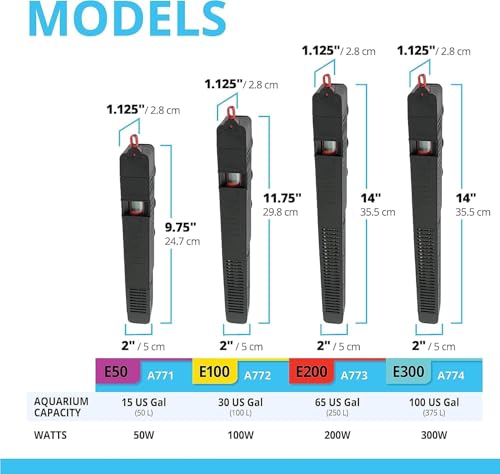
Fluval E Series Sizes: E50, E100, E200, and E300
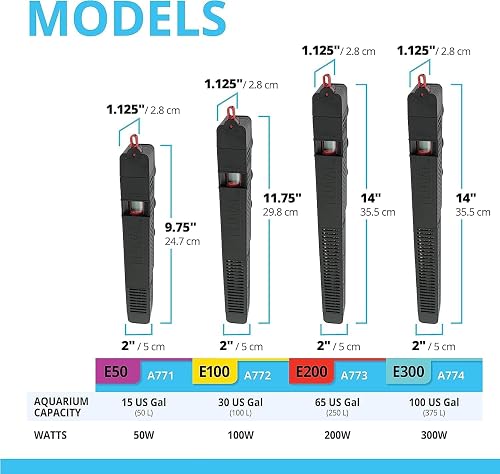
The manual lists four models by tank size:
| Model | Rated tank size | Heat output |
|---|---|---|
| E50 | Up to 15 US gal (60 L) | Not confirmed |
| E100 | Up to 30 US gal (120 L) | Not confirmed |
| E200 | Up to 65 US gal (250 L) | Not confirmed |
| E300 | Up to 100 US gal (375 L) | 300 watts (listing) |
Tank sizes are from the Fluval manual. If you are comparing Fluval heater 300W and smaller models by wattage, the manual lists the E50, E100, and E200 by tank size, not wattage, and we have no listing or Fluval page for those models, so we leave their output as not confirmed.
The manual’s tank sizes come with a caveat: they are approximate values for water up to 78°F (26°C) in a room at 68°F (20°C). It says a colder room, wide temperature swings, an open top, submersible pumps and filters, or a tank near a cooling source may call for a higher wattage. So a 75-gallon tank in a cool basement with an open top sits closer to the E300’s limit than the number suggests, while a covered 75-gallon tank in a warm living room has more margin.
How It Compares
Fluval E300 vs a standard bi-metallic heater: per the manual, the E series reads the water through the glass with an electronic sensor and has no bi-metallic contacts. The practical difference for you is the display: some basic heaters have no temperature readout at all, while the E300 shows the actual water temperature and color-codes how far it is from the set point.
Fluval E300 vs a heater with a separate controller: some setups use a heater paired with an external controller and probe, which lets you place the sensor away from the heater. The E300 keeps everything in one unit, which is simpler but means placement near water flow matters more. Our heaters and chillers section lists the aquarium heater reviews and guides we publish.
Who Should Look Elsewhere
- Owners of tanks over 100 gallons: the manual’s range for the E300 stops at 100 US gallons.
- Small tanks: per the manual, the E50, E100, and E200 cover tanks up to 15, 30, and 65 gallons; so a smaller model may suit those tanks better.
- Tanks with little circulation at the heater’s location: the heater needs nearby water flow, per the manual, or it shows a low flow warning.
- Ponds, outdoor tubs, and pools: the manual limits it to indoor aquarium use.
- Anyone who cannot confirm the voltage: if the label on the unit you receive does not match your outlets, return it.
Why You Should Trust Us
We do not conduct our own product trials; our reviews draw on published specifications, manufacturer documents, and listing data, and Amazon owner ratings also set each product’s AquariumTech Score. For this review, that meant one listing and Fluval’s E Series manual, each cited where used. Commissions on purchases through our links do not influence the score or the verdict; see How We Review for the method.
Final Verdict
The Fluval E300 suits a 65- to 100-gallon freshwater or saltwater tank whose owner wants to see the water temperature at a glance and set it in half-degree steps. Per the manual, it gives clear color feedback, two error codes, and a five-year warranty. The caveats are practical: place it near water flow, handle the glass core with care, and check the electrical rating on the unit before you plug it in, since the listing’s voltage field shows 230 V, which conflicts with Amazon.com selling it in the US.
Frequently Asked Questions
What size tank is the Fluval E300 heater for?
The manual rates the E300 for aquariums up to 100 US gallons (375 liters), based on water up to 78°F in a 68°F room. A colder room or an open top may call for more heating capacity.
Which Fluval E series heater should I buy?
Per the manual, the E50 covers tanks up to 15 US gallons, the E100 up to 30, the E200 up to 65, and the E300 up to 100. Pick the model whose range comfortably includes your tank, and note that the manual says a cool room may call for a higher wattage.
What do the colors on a Fluval E heater mean?
Per the manual, green means the water is within 2°F of the set temperature, red means it is warmer, blue means it is cooler, and a flashing display means it is more than 5.5°F away from the set point.
How do I switch a Fluval E heater between Fahrenheit and Celsius?
Hold the set lever in the full left position for at least five seconds until the new scale appears, then release it, per the manual.
What does LF or E1 mean on a Fluval heater?
LF means low water flow around the heater; improve circulation and it clears on its own. E1 means the heater detected an abnormal condition and cut power to the element; unplug it, check the setup and water level, and restart it, per the manual.
Can the Fluval E300 be used in a saltwater tank?
Yes. The manual marks the E series for fresh and saltwater aquariums.
About the author
Soham James is a fishkeeping enthusiast with a keen interest in aquarium technology and equipment selection. At AquariumTechLab.com, Soham explains filters, heaters, pumps, and monitoring tools, helping aquarists understand their options and choose equipment suited to their tanks.