
Seachem Flourish Review
Our Seachem Flourish review covers what the plant supplement contains, why it leaves out nitrogen and phosphorus, and how it compares with Flourish Tabs.
 Updated October 24, 2026

Seachem Flourish is a liquid plant supplement for freshwater planted aquariums, and this review covers the 500 ml bottle. It supplies iron, magnesium, calcium, and a long list of trace elements, but, per Seachem, no significant nitrogen or phosphorus, so it fills the micronutrient side of a fertilizer routine rather than the whole of it. It suits planted tanks where the fish already supply some nitrate and the plants look pale or slow. If your plants are short on nitrogen, phosphorus, or potassium, Flourish alone will not fix that.
We did not use this supplement ourselves. This review draws on three sources, each named where we use it: the Amazon listing for the 500 ml bottle, Seachem’s Flourish product page and the related Seachem pages linked below, and owner reviews posted on this same listing. Statements marked “per Seachem” come from Seachem’s pages; statements marked “per the listing” come from Amazon.
This review is general product information, not veterinary or dosing advice. Read the label and follow Seachem’s directions, keep aquarium chemicals out of reach of children, and do not combine products in one container. If fish or shrimp act unusually after a dose, stop dosing and contact a licensed aquatic veterinarian or Seachem’s support line.

We earn a commission from qualifying purchases made through links on this page. Commissions never affect our rankings or AquariumTech Scores.
Seachem Flourish Freshwater Plant Supplement





As an Amazon Associate we earn from qualifying purchases.
Seachem Flourish at a Glance
The source of each value is marked in the row.
| Item | Seachem Flourish, 500 ml |
|---|---|
| Type | Comprehensive supplement for the planted aquarium: micro elements, trace elements, and other nutrients (listing and Seachem) |
| Nitrogen and phosphorus | No significant levels (listing and Seachem) |
| Intended for | The natural freshwater aquarium (Seachem) |
| Effect on pH | Will not alter pH when used as directed (Seachem FAQ) |
| Shrimp and other invertebrates | Described by Seachem as safe for invertebrates such as shrimp |
| Storage | Refrigeration recommended 3 months after opening (Seachem) |
| Other sizes | 50 mL up to 4 L (Seachem) |
| Model number | 67105130 (listing) |
| Package size | 7.7 x 2.1 x 1.6 inches; 1.2 pounds (listing) |
What Seachem Flourish Contains, and What It Leaves Out
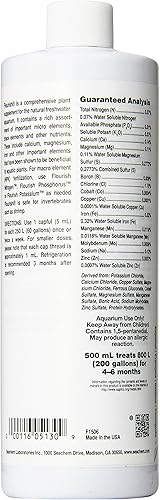
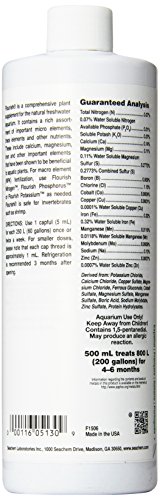
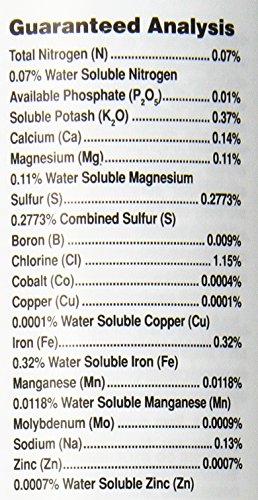
Seachem describes Flourish as a comprehensive supplement with a rich assortment of micro elements, trace elements, and other nutrients, and names calcium, magnesium, and iron among them. Its published analysis is given as a percentage by weight, and Seachem’s FAQ notes that those percentages hold for any unit you measure, not for a single dose. Selected values from Seachem’s page:
| Component | Percent by weight (per Seachem) |
|---|---|
| Soluble potash (K2O) | 0.37% |
| Iron (Fe) | 0.32% |
| Calcium (Ca) | 0.14% |
| Magnesium (Mg) | 0.11% |
| Manganese (Mn) | 0.0118% |
| Total nitrogen (N) | 0.07% |
| Available phosphate (P2O5) | 0.01% |
| Copper (Cu) | 0.0001% |
Two things stand out. First, the nitrogen and phosphate figures are small next to the iron, which matches how Seachem positions the product: for macro element (NPK) fertilization, it points buyers to Flourish Nitrogen, Flourish Phosphorus, or Flourish Potassium as needed. Seachem argues that packing every nutrient into one bottle leads to overdosing micronutrients when you try to raise macronutrients, so it keeps them apart.
Second, the list includes copper. Seachem’s FAQ says the amount is so small that you would have to massively overdose before approaching a level that harms even sensitive animals, and that tap water usually carries more copper than Flourish adds. That is the maker’s position; the practical takeaway is to stay at the label dose if you keep shrimp or snails.
Seachem’s FAQ also says the color varies from batch to batch with the blending temperature and does not affect function, so a darker bottle than your last one is not by itself a sign of a problem.
Which Planted Tanks Get the Most From Flourish
Because Flourish covers micronutrients and leaves macronutrients to other products, the useful question is what your tank is already short of. Some common setups:
- Low-tech tank with fish and slow growers: a 20-gallon tank with Java fern, anubias, and a modest fish load often gets its nitrogen and phosphorus from fish waste and food. Plants tied to wood or rock have no roots in the substrate and take nutrients from the water, which is where a liquid such as Flourish works.
- Rooted plants in plain gravel: swords and cryptocorynes feed heavily through their roots. Seachem’s Flourish Tabs FAQ says some plants take in more through their roots and some through their leaves, and that using Flourish with Flourish Tabs addresses both. Under heavy root feeders, tabs may matter more than the liquid.
- Heavily planted tank with few fish: when plants outnumber the fish, nitrate can run out. Flourish will not supply it, so check nitrate with a test kit, and if it reads near zero while growth stalls, a nitrogen source is the missing piece.
- High-light tank on a pressurized CO2 system: fast growth uses trace elements quickly. Seachem’s Flourish Trace page says that when growth is substantial, trace elements are often used up faster than the other components of Flourish, and suggests adding Flourish Trace, staggered with Flourish rather than used together.
Seachem Flourish vs Flourish Tabs, Nitrogen, Advance, and Trace
The Flourish name covers several products, and search results blur them together. Here is how Seachem describes each on its product pages:
| Product | Form | What Seachem says it supplies | Consider it when |
|---|---|---|---|
| Flourish | Liquid | Micro elements, trace elements, and other nutrients; no significant nitrogen or phosphorus | Plants look pale or slow and fish already supply some nitrate |
| Flourish Tabs | Tablets pushed into the gravel | The nutrients found in Flourish in dry form, aimed at the root zone; no phosphate or nitrate | Rooted plants sit in inert gravel or sand |
| Flourish Nitrogen | Liquid | Nitrogen in both nitrate and ammonium forms; Seachem says no free ammonia is released | Nitrate runs near zero and growth is stunted |
| Flourish Advance | Liquid | Phytohormones, minerals, and nutrients described as a growth enhancer for roots and shoots | Nutrients are covered and you want the growth boost Seachem describes |
| Flourish Trace | Liquid | Trace elements only | Fast growth uses up trace elements between Flourish doses |
On Flourish versus Flourish Tabs, Seachem’s FAQ says the two are similar in function and it generally suggests one or the other, while noting that some tanks benefit from both. The same FAQ says that a clay substrate such as Flourite is a rich source of iron and some minerals but is primarily a porous gravel base, and that tabs supply a broader range of minerals than the substrate alone.
Flourish Nitrogen is the bottle Seachem pairs with Flourish when nitrogen is the limit; its page lists stunted growth and chlorosis as signs of nitrogen deficiency. Flourish Advance is a different kind of product. Seachem describes it as a phytohormone supplement and says that for the first ten to fourteen days it works on roots, after which leaf and stem growth picks up. That timeline is the maker’s claim; we found no independent data on it.
Reading Your Plants Before You Dose
Seachem publishes a chart of Flourish constituents and signs of deficiency. A few rows that aquarium keepers run into most:
| Element | Sign of deficiency (per Seachem’s chart) |
|---|---|
| Iron | Chlorosis of the tissue between veins, short and slender stems; affects young leaves |
| Magnesium | Chlorosis; older leaves most affected |
| Potassium | Chlorosis, necrosis, weak stems and roots; older leaves most affected |
| Nitrogen | Stunted growth and chlorosis; affects the whole plant |
| Phosphorus | Stunted growth, plant dark green; affects the entire plant |
The overlap is the catch. Pale leaves can point to iron, magnesium, or nitrogen, and a chart cannot tell you which on its own. Flourish addresses the iron and magnesium rows; it does little for nitrogen or phosphorus. Before adding more of anything, check the light schedule, the nitrate reading, and how recently the plants went in. If you are still sorting out the basics of plant care, start there before you add a second bottle.
What Owners Say
These points come only from owner reviews posted on this listing.
- New growth within a couple of weeks: one owner with a 29-gallon tall tank says yellowing plants greened back up after two weeks, and another with a 20-gallon tank describes plants going from brown to bright green over the same span.
- Easy to dose: one owner says the dosing is straightforward and the liquid mixes in without clouding the water.
- Light and CO2: the same owner says Flourish is designed for tanks with good light and CO2. Seachem’s Flourish page sets no light or CO2 requirement, so treat that as one keeper’s experience.
- Mixed results: a less enthusiastic review describes a plant that put out a few new leaves and then stalled again, with no visible effect on water quality or fish.
- Storage: the only drawback one owner lists is the need to refrigerate it.
One short review credits the product with clearing ich from fish. Flourish is a plant supplement, not a medication, and Seachem’s page makes no such claim. If your fish show signs of illness, contact a licensed aquatic veterinarian.
What We Like
- Covers micronutrients without pushing nitrate or phosphate up, per Seachem.
- Seachem publishes a nutrient analysis and a deficiency chart, so you can see what you are adding.
- Will not alter pH when used as directed, per Seachem.
- Described by Seachem as safe for invertebrates such as shrimp.
- Owners on this listing report visible new growth within a couple of weeks.
What Could Be Better
- Not a complete fertilizer: tanks short on nitrogen, phosphorus, or potassium need a second product.
- Seachem recommends refrigeration once the bottle has been open for 3 months.
- Contains copper in trace amounts, so the label dose matters more in shrimp and snail tanks.
- Seachem’s safety note says it contains 1,5-pentanedial and may produce an allergic reaction.
- Results vary: one owner saw growth stall after an early response.
Using Flourish by the Label
We do not give doses here. Seachem prints its directions on the bottle and offers a dosage calculator on its Flourish page that scales the amount to tank volume. A few label-level points:
- Measure small doses: Seachem notes that the cap threads give a smaller measure for small tanks, which beats guessing on a nano tank.
- Space out related products: if you also use Flourish Trace, Seachem says to dose the two on alternate days.
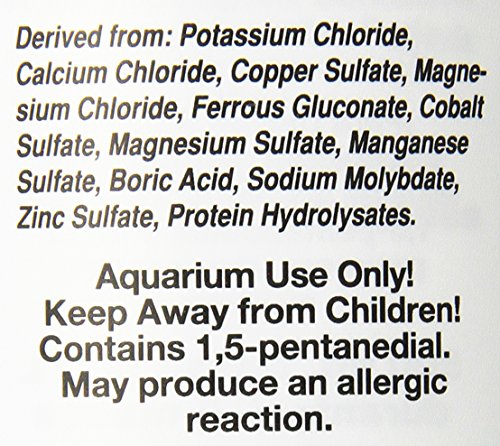
- Read the safety note: the safety section of Seachem’s Flourish page reads “Aquarium Use Only! Keep Away from Children!” and warns that the product contains 1,5-pentanedial and may produce an allergic reaction. Keep it in its original bottle, out of reach, and away from food.
- Aquarium use only: Seachem’s FAQ says its products are strictly intended for aquarium use, so do not use Flourish on vegetables or anything grown to eat.
How It Compares
Against an all-in-one liquid fertilizer: an all-in-one aims to cover nitrogen, phosphorus, and potassium along with micronutrients in a single bottle. Flourish deliberately does not, which means more bottles but finer control over each nutrient. If you would rather buy one product for a lightly stocked tank, our aquarium plant fertilizer roundup compares the options by type.
Against root tabs: tabs feed the substrate, not the water. For swords, crypts, and other heavy root feeders in plain gravel, compare root tab options first, and add Flourish if epiphytes or stem plants also need help. You can browse more planted tank gear in our planted tank section.
Against CO2: Flourish is a nutrient source, not a carbon source. If plants stay pale with nutrients covered, light and carbon may be the limit, and a broader look at adding CO2 is the better next step.
Who Should Look Elsewhere
- Keepers who want one complete fertilizer: Flourish leaves out meaningful nitrogen and phosphorus by design.
- Tanks with nitrogen-starved plants: start with a nitrogen source, not more micronutrients.
- Root feeders in inert gravel with no epiphytes: root tabs reach the roots directly.
- Saltwater and reef tanks: Seachem describes Flourish for the natural freshwater aquarium.
Why You Should Trust Us
We do not conduct our own product trials. This review draws on manufacturer pages, the Amazon listing, and the owner reviews posted on that listing; owner ratings also feed each product’s AquariumTech Score. For this review we read the full Amazon listing, every owner review stored for this listing, and Seachem’s product pages and deficiency chart, and we mark each claim with its source. Commissions never affect our rankings or AquariumTech Scores. Our How We Review page explains the method.
Final Verdict
Seachem Flourish is a well-documented micronutrient supplement. Seachem publishes what is in it, what it leaves out, and how it fits with its other plant products, and owners on this listing describe greener new growth within a couple of weeks. Buy it for a planted freshwater tank where fish already supply some nitrogen and the plants look pale or slow. Pair it with root tabs for heavy root feeders and with a nitrogen source if nitrate runs low, and skip it if you want a single bottle that covers everything.
Frequently Asked Questions
Is Seachem Flourish safe for shrimp?
Seachem says Flourish is safe for invertebrates such as shrimp, and its FAQ addresses the copper content directly: the amount is very small, and Seachem says you would have to massively overdose before approaching a harmful level. Stay at the label dose and watch your shrimp after the first few doses.
Does Seachem Flourish contain nitrogen?
Very little. Per Seachem, it does not contain significant levels of nitrogen or phosphorus, and its analysis lists total nitrogen at 0.07% by weight. For nitrogen, Seachem points to Flourish Nitrogen, which it says supplies both nitrate and ammonium.
Do I need both Flourish and Flourish Tabs?
Not always. Seachem says the two are similar in function and generally suggests one or the other, but notes that root feeders and leaf feeders differ, so some tanks benefit from both. Tabs make the most sense under rooted plants in inert gravel or sand.
What is the difference between Flourish and Flourish Advance?
Flourish supplies micronutrients and trace elements. Seachem describes Flourish Advance as a phytohormone supplement meant to stimulate root and shoot growth. They are separate products with separate labels, so follow each one’s directions.
Does Seachem Flourish need to be refrigerated?
Seachem recommends refrigeration 3 months after opening. One owner on this listing names that as the only drawback.
Will Seachem Flourish cause algae?
Seachem’s FAQ says the phosphorus content is so low that, at its recommended dose, the phosphate added is negligible and poses no algae risk. If algae appears after you start dosing, check the light schedule and feeding before adding more of anything.
About the author
Noelle Young is a planted aquarium enthusiast with a special interest in aquascaping and aquatic plant care. At AquariumTechLab.com, Noelle covers aquarium lighting, substrates, and CO₂ equipment, helping hobbyists choose setups that support healthy plant growth and fish wellbeing.