
Seachem Stability Review
Our Seachem Stability review explains what the bottled bacteria can and cannot do for a new tank, how it fits alongside Prime, and why a test kit still matters.
 Updated October 24, 2026

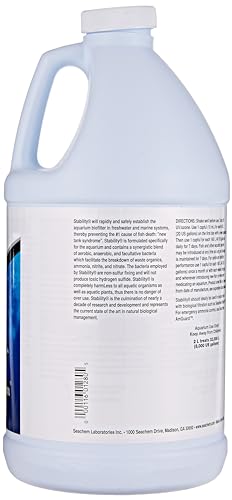
Seachem Stability is a bottled bacteria product meant to help a new freshwater or saltwater aquarium build its biofilter, and this review covers the 2 L (67.6 oz) bottle. According to Seachem, it contains a blend of aerobic, anaerobic, and facultative bacteria that break down waste organics, ammonia, nitrite, and nitrate, and the bacteria ship in a dormant spore form that needs no refrigeration. It is a reasonable way to seed a new tank, but it is not an ammonia detoxifier, and Seachem itself says most tanks still take weeks to cycle, so an ammonia and nitrite test kit stays essential.
We did not use this product ourselves. This review draws on the Amazon listing for the 2 L bottle, Seachem’s Stability product page and FAQ, Seachem’s article on ammonia management, an aquaculture fact sheet and a university extension publication on biofilters and ammonia, and owner reviews posted on this same listing. Claims marked “per Seachem” come from Seachem’s pages.
This review is general product information, not veterinary or dosing advice. Read the label and follow Seachem’s directions, keep water treatments out of reach of children, and do not combine products in one container. If fish gasp at the surface, stop eating, or act unusually, contact a licensed aquatic veterinarian.

We earn a commission from qualifying purchases made through links on this page. Commissions never affect our rankings or AquariumTech Scores.
Seachem Stability Fish Tank Stabilizer




As an Amazon Associate we earn from qualifying purchases.
Seachem Stability at a Glance
The source of each value is marked in the row.
| Item | Seachem Stability, 2 L |
|---|---|
| Type | New tank stabilization system (Seachem) |
| Water type | Freshwater and marine (Seachem and listing) |
| Contents | Aerobic, anaerobic, and facultative bacteria (Seachem) |
| Form | Liquid (listing); bacteria in spore form, no refrigeration needed (Seachem FAQ) |
| Hydrogen sulfide | Non-sulfur fixing bacteria that will not produce hydrogen sulfide (Seachem) |
| Shelf life | 6 years from date of manufacture (Seachem) |
| Other sizes | 50 mL up to 4 L (Seachem) |
| Model number | 001064 (listing) |
| Package size | 9.8 x 4.6 x 4.6 inches; 2.6 pounds (listing) |
What Seachem Stability Does, and What It Does Not
A fact sheet from the Southern Regional Aquaculture Center explains the chain: one group of bacteria converts toxic ammonia to nitrite, which is also toxic, and another converts nitrite to nitrate. A new filter has too few of these bacteria, which is why new tanks see ammonia and nitrite spikes. Stability aims to shorten that gap with bacteria from a bottle.
Seachem makes several specific claims for it:
- Dormant until added. Per Seachem’s FAQ, the bacteria are alive but not active, in spore form, become active when diluted in the aquarium, and need no refrigeration. Seachem says the bacteria should find a place to attach within 24 hours.
- No hydrogen sulfide. Per Seachem, the bacteria are non-sulfur fixing and will not produce toxic hydrogen sulfide.
- Seachem says overuse is low risk. Seachem calls Stability harmless to aquatic organisms and plants, and its FAQ says the worst result of too much is a bacterial bloom in the water column, which it describes as rare and self-clearing.
What Stability does not do matters just as much. It does not bind or detoxify ammonia the way a conditioner does. On its Stability page, Seachem points to a different product, AmGuard, for emergency ammonia control, and its AmGuard page in turn recommends Stability and Matrix for long-term ammonia control. Stability builds the bacteria; it is not a rescue for a tank that already shows high ammonia.
It also does not make cycling instant. Seachem’s FAQ says every tank cycles differently and most are cycled within 4 to 6 weeks. The University of Florida’s extension publication Ammonia in Aquatic Systems gives six to eight weeks for a new biofilter to build up enough bacteria. The SRAC fact sheet describes bacterial preparations as not essential, but says they can shorten the time it takes to establish a biofilter. Expect a head start, not a shortcut past monitoring. Our guide to cycling a fish tank walks through the full process.
Using Stability by the Label
We do not list doses or schedules here; follow the label on your bottle. What Seachem’s directions and FAQ cover, without the numbers:
- Shake first, and switch off UV and ozone. Seachem’s FAQ explains that UV and ozone break down and kill bacteria, so both should stay off during the dosing period the label describes.
- A starting course for new tanks. The directions give a first-day amount, then a daily course at a lower amount. Seachem says fish may be added at any point while that course is kept up.
- Ongoing use. Seachem also suggests a maintenance amount monthly or at water changes, and whenever new fish are added or the tank is medicated.
- A place for the bacteria to live. Seachem says Stability should ideally be used alongside biological filtration such as its Matrix media.
- A fishless cycle needs an ammonia source. Seachem’s FAQ suggests a pinch of food daily until ammonia shows up on a reading.
The medication point lines up with the University of Florida publication, which says some disease treatments, especially antibiotics, can harm the nitrifying bacteria in a biofilter, and that ammonia and nitrite should be checked more often after treating. For an ammonia source other than fish food, our article on household ammonia for a fishless cycle covers which products to avoid.
Track the Cycle With a Test Kit
Only readings can tell you whether the bacteria took hold. The University of Florida publication says all hobbyists should invest in a dependable water quality test kit, and the SRAC fact sheet lists ammonia, nitrite, pH, temperature, and alkalinity as the main parameters to watch while a biofilter starts. What a working cycle looks like, per SRAC: ammonia rises to a high point and then declines, and after a lag, nitrite rises and then declines.
- Keep ammonia in check. Seachem’s ammonia management article notes that free ammonia is toxic to nitrifying bacteria and that high ammonia is a major cause of difficulty in establishing a biological filter. More ammonia does not mean a faster cycle.
- Give the bacteria what they need. According to the University of Florida, both groups of nitrifying bacteria need oxygen and alkalinity to function.
- Know your kit. One owner on this listing used Stability alongside Prime, an ammonia-binding conditioner, and another recommends a detoxifying conditioner such as Prime during a cycle. Seachem’s guidelines for using test kits say Nessler and salicylate ammonia kits also count ammonia bound by those conditioners, which can make readings hard to interpret.
If a reading looks wrong or keeps climbing, our guide to ammonia in a fish tank explains the causes and next steps.
Seachem Stability in Saltwater and Reef Tanks
Seachem markets Stability for both freshwater and marine systems, and the listing title says the same. The SRAC fact sheet, written for aquaculture systems rather than home reef tanks, notes that some operators find bacterial cultures essential for starting biofilters in brackish or marine conditions, and that nitrifying bacteria species differ in the salinity they tolerate. A reef tank adds its own steps, which our guide to cycling a reef tank covers.
What Owners Say
These points come only from owner reviews posted on this listing.
- Cycling timelines: one new keeper with a betta in a 5-gallon tank says it cycled in 19 days while they monitored the water and used Prime, and blames the betta’s small bioload for the wait. Another says a tank cycled in about three weeks, ammonia first, then nitrite. These are single accounts; cycle time depends on the tank, stocking, filter, and water.
- Cloudiness and biofilm: the same keeper went a little over the label amount and saw cloudy water and a heavy surface biofilm, worsened by a baffled filter outflow, which cleared on its own as the filter matured. The cloudiness resembles the bloom Seachem’s FAQ describes; the surface film is the owner’s own observation, tied to a baffled outflow.
- Use after a disturbance: one owner lost fish after rearranging decor and believes Stability helped the rest; another adds it after large water changes or filter maintenance. We cannot confirm either account.
- The measured view: the most detailed review, from a keeper running several new tanks, argues there is no true shortcut to a cycled tank, rates Stability highly for protecting fish in a tank not yet cycled, and sees little point in routine dosing of an established tank.
- The overconfident view: one owner describes adding fish minutes after dosing with no cycling at all. Seachem’s own product page and FAQ still expect weeks for most tanks, so keep reading ammonia and nitrite if you add fish early.
- Bottle life: one owner who doses at water changes describes the liquid as easy to dose and the bottle as lasting a while.
What We Like
- Spore-form bacteria that need no refrigeration, per Seachem.
- Labeled for both freshwater and marine tanks.
- Seachem’s product page and FAQ are candid that tanks still take weeks and that the bottle is not an ammonia rescue.
- A long shelf life, per Seachem.
- Several owners describe a smoother start for new tanks.
What Could Be Better
- No reliable cycle time; Seachem and owners both describe weeks, and results vary by tank.
- Does nothing for an ammonia spike already in progress; Seachem points to AmGuard for that.
- UV sterilizers and ozone have to be switched off during dosing, per Seachem.
- Cloudy water or a bacterial bloom is possible, per Seachem and one owner.
- The 2 L size is far more than one small tank needs, and the listing has data errors.
Seachem Stability vs Prime and AmGuard
Seachem Prime: a water conditioner. According to Seachem, it removes chlorine and chloramine and renders ammonia, nitrite, and nitrate non-toxic, and its Prime page recommends Stability when adding new fish. Prime treats the water; Stability supplies the bacteria, so Seachem Prime and Stability are meant to be used together, not chosen between. Our Seachem Prime review covers the conditioner side.
Seachem AmGuard: the ammonia binder Seachem’s Stability page names for emergencies. Reach for a binder when a reading is already high; use Stability to build the filter that prevents the next spike.
Other brands: several makers sell bottled bacteria; compare labels and sources the same way before you buy. Browse more water care in our water care section.
Is Seachem Stability Right for Your Tank?
- A new tank, fishless: the strongest fit. Add an ammonia source as Seachem describes and track readings until ammonia and nitrite both fall.
- A new tank with fish already in it: Seachem allows this while the starting course is maintained. Read ammonia and nitrite often; the SRAC fact sheet calls stocking without an active biofilter a slow and stressful process.
- After medication or new fish: Seachem suggests dosing at these points, and the University of Florida warns that some treatments can harm a biofilter. Pair the dose with closer monitoring.
- An established, stable tank: Seachem suggests periodic doses for optimum biofilter performance, while the most detailed owner review sees little need. Your readings are the better guide.
- Bottle size: Seachem sells Stability from 50 mL up to 4 L. The 2 L bottle suits large tanks, several tanks, or regular use at water changes; one small tank is better served by a smaller bottle.
Notes on the Amazon Listing
The listing description tracks Seachem’s page closely, but two fields contain errors. The Liquid Volume field reads 2 ml, while the title says 2 L and 67.6 oz and Seachem sells a 2 L size; 2 L works out to about 67.6 fl oz, so the title is the figure to trust. One feature bullet also garbles Seachem’s “non-sulfur fixing” wording. Because of the volume field error, we lowered its AquariumTech Score by an editorial adjustment, as described on our How We Review page.
Who Should Look Elsewhere
- Anyone facing an ammonia spike right now: Seachem points to AmGuard for emergency ammonia control, so a binder, water changes, and frequent readings come first; if fish show distress, contact a licensed aquatic veterinarian.
- Keepers who want to skip the cycle: no bottle replaces monitoring, and Seachem’s own product page and FAQ still expect most tanks to take weeks.
- Tanks that must keep UV or ozone running: Seachem says both should be off while dosing.
- Owners of one small tank: a smaller Stability bottle is a better fit than 2 L.
- Anyone treating sick fish: Stability is not a medication; contact a licensed aquatic veterinarian.
Why You Should Trust Us
We do not conduct our own product trials. This review draws on manufacturer pages, university extension publications, the Amazon listing, and the owner reviews posted on that listing; owner ratings also feed each product’s AquariumTech Score. For this review we read the full listing and every owner review stored for it, Seachem’s product pages and articles, and the two extension publications, and we mark each claim with its source. Commissions never affect our rankings or AquariumTech Scores.
Final Verdict
Seachem Stability is a sensible way to give a new freshwater or saltwater biofilter a head start, and Seachem is unusually direct that it does not replace the weeks a cycle takes or the job of an ammonia binder. Buy it to seed a new tank or support a filter after medication, alongside a conditioner and a reliable test kit. Do not expect fish-ready water overnight, and choose a smaller bottle for one small tank.
Frequently Asked Questions
Can you use Seachem Prime and Stability together?
Yes. Seachem’s Prime page recommends Stability when adding new fish and calls the two ideal for use together. According to Seachem, Prime conditions the water and renders ammonia non-toxic, while Stability adds bacteria. Follow each label separately and do not mix them in one container.
Does Seachem Stability remove ammonia?
Indirectly. Per Seachem, its bacteria break down ammonia, nitrite, and nitrate as they establish, which takes time. It does not bind ammonia on contact, and Seachem points to AmGuard for emergency ammonia control. Confirm progress with an ammonia test kit.
Does Seachem Stability work in saltwater tanks?
Seachem labels it for freshwater and marine systems. Reef keepers should note Seachem’s direction to turn off UV sterilizers and ozone while dosing, since both kill bacteria.
Can you overdose Seachem Stability?
Seachem’s FAQ says it is very hard to overdose and that the worst outcome is a rare bacterial bloom that clears on its own. One owner who went over the label amount saw cloudy water and biofilm that cleared later. Stay within the label anyway.
How long does it take to cycle a tank with Seachem Stability?
There is no fixed answer. Seachem says every tank cycles differently and most are cycled within 4 to 6 weeks, and the University of Florida gives six to eight weeks for a new biofilter. Judge the cycle by your readings, with ammonia and then nitrite rising and falling back down, not by when the bottle’s course ends.
About the author
Marsha Bates is an aquarium enthusiast focused on freshwater fishkeeping and everyday tank maintenance. At AquariumTechLab.com, Marsha shares practical guides on tank setup, water quality, and essential equipment to help beginners build healthy, manageable aquariums.