
Seachem Prime Review
Our Seachem Prime review explains how the conditioner handles chlorine, chloramine, and ammonia, what it cannot do, and why it can confuse ammonia test kits.
 Updated October 24, 2026

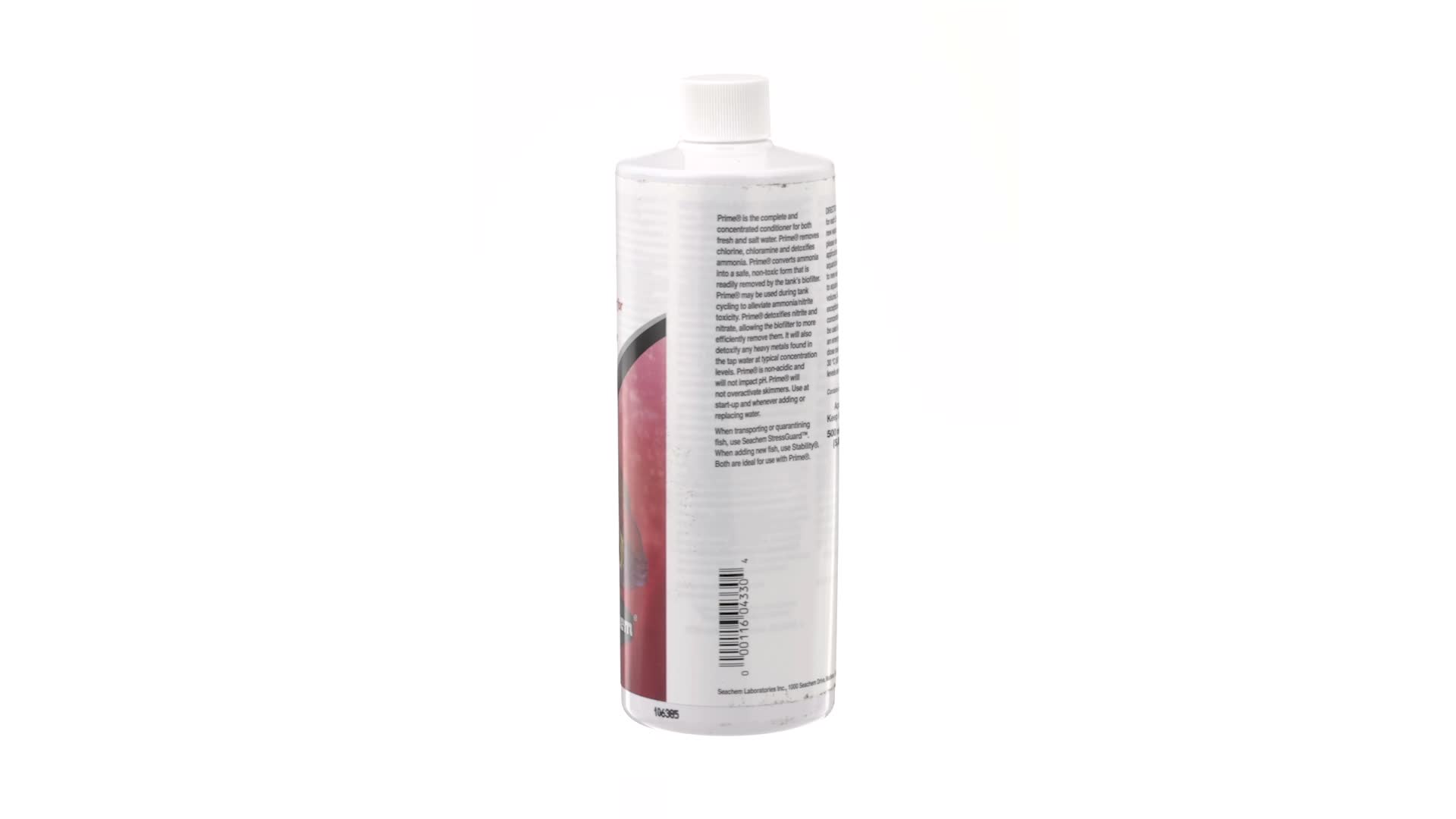
Seachem Prime is a concentrated liquid water conditioner for freshwater and saltwater aquariums, and this review covers the 500 ml (17 fl oz) bottle. According to Seachem, it removes chlorine and chloramine and binds ammonia for up to 48 hours in a non-toxic form while the biofilter catches up, and it says it also detoxifies nitrite and nitrate, though it calls that mechanism not well understood. For anyone on chloraminated tap water, it is a sound default conditioner. What it does not do is remove ammonia, replace a cycled filter, or stand in for water changes, and it can confuse some ammonia test kits.
We did not use this conditioner ourselves. This review draws on the Amazon listing for the 500 ml bottle, Seachem’s Prime product page and FAQ, Seachem’s article on freshwater aquarium conditioning, a page from the US Environmental Protection Agency on chloramines, and owner reviews posted on this same listing. Statements marked “per Seachem” come from Seachem’s pages; statements marked “per the listing” come from Amazon.
This review is general product information, not veterinary or dosing advice. Read the label and follow Seachem’s directions, keep water treatments out of reach of children, and do not combine products in one container. If fish gasp at the surface, stop eating, or act unusually, contact a licensed aquatic veterinarian.

We earn a commission from qualifying purchases made through links on this page. Commissions never affect our rankings or AquariumTech Scores.
Seachem Prime Water Conditioner


As an Amazon Associate we earn from qualifying purchases.
Seachem Prime at a Glance
The source of each value is marked in the row.
| Item | Seachem Prime, 500 ml |
|---|---|
| Type | Complete and concentrated conditioner (Seachem) |
| Water type | Freshwater and saltwater (Seachem and listing) |
| Removes | Chlorine and chloramine (Seachem) |
| Binds | Ammonia, nitrite, and nitrate, for up to 48 hours (Seachem FAQ) |
| Heavy metals | Detoxifies heavy metals found in tap water at typical concentrations (Seachem) |
| Effect on pH | Non-acidic; will not impact pH (Seachem) |
| Reef tanks | Will not over-activate protein skimmers (Seachem) |
| Shelf life | Lasts indefinitely if stored properly (Seachem FAQ) |
| Other sizes | 50 mL up to 4 L (Seachem) |
| Model number | 67104330 (listing) |
| Package size | 6.6 x 2.5 x 2.3 inches; 1.3 pounds (listing) |
How Seachem Prime Handles Chlorine, Chloramine, and Ammonia
Chloramine is the reason Prime’s ammonia handling matters. According to the US Environmental Protection Agency, many public water systems use chlorine as their primary disinfectant, some use chloramines as a secondary disinfectant, and chloramines are most commonly formed when ammonia is added to chlorine. The same page says more than one in five Americans uses drinking water treated with chloramines. Your water utility can tell you which one comes out of your tap.
Seachem’s FAQ explains what happens next. When a conditioner strips the chlorine from chloramine, ammonia is left behind. Prime binds that ammonia, and Seachem says the bound form stays available to the beneficial bacteria, so Prime will not halt the cycling process. A conditioner that only neutralizes chlorine would leave that ammonia free in the tank. Seachem’s conditioning article makes the same point about thiosulfate treatments, which it calls inadequate for chloramine because they release ammonia.
Seachem also says Prime is up to five times more concentrated than competing products. That is the maker’s comparison, not a figure we could check, but owners on this listing consistently describe how little each water change needs. If you are still deciding between tap, RO, and bottled water, our guide to choosing water for a fish tank covers each source.
What Prime Does Not Do
Prime is a conditioner, not a filter, and Seachem’s FAQ is direct about its limits:
- It does not remove ammonia, nitrite, or nitrate. Per Seachem, it binds them, making them harmless to the fish while leaving them available to the bacteria.
- The binding is temporary. Seachem says Prime holds these compounds for up to 48 hours; anything still present after that is released back into the water unless Prime is dosed again.
- The nitrite and nitrate effect is not fully explained. Seachem says the way Prime detoxifies nitrite and nitrate is not well understood from a mechanistic standpoint, and that its confidence comes from repeated customer reports. That is unusually candid for a maker, and worth weighing before you treat Prime as a fix for high nitrate.
- It does not build a biofilter. Seachem sells bacteria separately, and its Prime page suggests Stability when adding new fish.
So Prime buys time during an ammonia or nitrite spike, but water changes and a working biofilter still have to remove the waste. Our guide to ammonia in a fish tank covers the causes and the steps that lower it.
Prime and Your Ammonia Test Kit
This is the question Seachem’s FAQ answers at greatest length, and it trips up new keepers during cycling. Per Seachem:
- A Nessler-based ammonia kit will not read correctly while Prime is in the water; the result looks off scale, a muddy brown.
- A salicylate-based kit can be used with caution, but under the kit’s conditions the bound ammonia eventually breaks down and gives a false reading, so read the result right away.
- A tap water reading taken right after adding Prime can still show ammonia: that is the ammonia left when chloramine loses its chlorine.
Seachem points to its own MultiTest Ammonia kit, which it says uses a gas exchange sensor that Prime does not affect and can tell free ammonia apart from total ammonia. For other kit choices, see our aquarium test kit roundup.
Using Prime by the Label
We do not list doses here; follow the label on your bottle. What Seachem’s directions cover, without the numbers:
- New water first: Seachem says Prime may be added to the tank directly but works better added to the new water first, and that a dose added to the tank should be based on the tank’s full volume.
- Know which case applies: the directions give a standard dose, a higher dose Seachem says may be used for exceptionally high chloramine, a larger emergency dose for nitrite, and a reduced dose for very warm water when chlorine or ammonia levels are low. Follow the label case that fits your tank.
- Small tanks: Seachem notes that the cap threads give a smaller measure for small volumes. On a small tank the amount per water change is tiny, which is exactly what a new owner on this listing says caused confusion at first.
- Smell and specks: Seachem says the sulfur odor is normal, as are occasional small black specks at the bottom of the bottle. Its FAQ adds that the smell can vary between batches, sometimes closer to garlic.
- Storage: keep the bottle closed and away from children and food. Seachem says Prime does not expire as long as it has been stored properly.
What Owners Say
These points come only from owner reviews posted on this listing.
- A bottle that lasts: concentration is the most common theme. One owner who doses home tanks and a classroom aquaponics system says this size takes a long time to use up, even with regular refills.
- A buffer during cycling: several owners say they rely on it while a tank cycles or when ammonia starts to rise, describing it as a way to hold things steady until the filter catches up.
- The smell: two owners mention the sulfur-like odor, and one says it fades once the conditioner is in the water.
- Dosing small tanks: a new keeper found the dosing confusing at first because so little treats so much water, and advises small-tank owners to read the directions closely.
- Gasping after water changes: one owner reports fish gasping at the surface after water changes when freshly dosed water went straight into the tank, and changed the routine to let treated water stand first. That is one keeper’s account and not something Seachem’s page describes; if fish gasp after a water change, contact a licensed aquatic veterinarian.
- The skeptic: the most critical review accepts that Prime handles chloramine but disputes the ammonia claim, and argues that keepers whose tap water carries ammonia should not count on Prime alone while cycling a tank with fish in it.
Some owners also credit Prime with improvements in their fish’s health. We leave those out: water quality has many causes, and a single review cannot pin a change on one bottle.
What We Like
- Handles both chlorine and chloramine, per Seachem.
- Binds the ammonia that chloramine leaves behind, so a water change does not add free ammonia, according to Seachem.
- Non-acidic and will not impact pH, and Seachem says it will not over-activate skimmers on reef tanks.
- Seachem is open about what Prime does not do, including the temporary binding window.
- Owners consistently describe a bottle that lasts a long time.
What Could Be Better
- The binding lasts up to 48 hours, per Seachem, and does not remove the waste.
- Throws off Nessler-based ammonia kits and requires prompt reading with salicylate kits, per Seachem.
- Seachem itself says the nitrite and nitrate mechanism is not well understood.
- The concentrate makes small-tank doses easy to get wrong.
- Strong sulfur smell, which Seachem says is normal.
Seachem Prime vs Safe and Stability
Seachem Safe: Seachem describes Safe as a super-concentrated dry conditioner, and its conditioning article says Safe performs the same primary functions as Prime. The difference is the form. Seachem’s Safe FAQ says the powder lacks the stabilizers that keep Prime stable as a liquid, so it should not be premixed and stored. Safe suits keepers who treat large volumes and are comfortable measuring powder; Prime is simpler for everyone else.
Seachem Stability: a different job. Seachem describes Stability as a blend of bacteria that establishes the biofilter, and its Prime page lists the two as ideal for use together. Prime manages the water you add; Stability builds the bacteria that remove waste. Stability is a separate Seachem product with its own page.
Other brands: for conditioners from other makers, see our water conditioner roundup, and browse more water care in our water care section.
Notes on the Amazon Listing
The listing’s feature bullets track Seachem’s page closely, but one field is wrong and another is unexplained. The Included Components field lists pet toys and toy balls, which has nothing to do with a bottle of water conditioner, and the listing carries four different UPC codes without explaining them. The title gives the size as 500 ml and 17 fl oz; 500 ml works out to about 16.9 fl oz, so those agree after rounding. Because of the components error, we lowered its AquariumTech Score by an editorial adjustment, as described on our How We Review page.
Who Should Look Elsewhere
- Keepers cycling with fish who expect a conditioner to carry the tank: Prime’s binding is temporary, so plan on water changes, a bacteria source, and close monitoring.
- Anyone relying on a Nessler ammonia kit: switch kits or expect confusing readings.
- Keepers treating very large volumes who prefer a powder: Seachem Safe does the same primary job in dry form, per Seachem.
- Owners of very small tanks who do not want to measure tiny amounts: a less concentrated conditioner is easier to dose.
- Anyone looking for a disease treatment: Prime is a conditioner, not a medication.
Why You Should Trust Us
We do not conduct our own product trials. This review draws on manufacturer pages, the Amazon listing, and the owner reviews posted on that listing; owner ratings also feed each product’s AquariumTech Score. For this review we read the full Amazon listing, every owner review stored for this listing, Seachem’s Prime, Safe, and Stability pages, and Seachem’s conditioning article, and we mark each claim with its source. Commissions never affect our rankings or AquariumTech Scores.
Final Verdict
Seachem Prime water conditioner does the core job well on paper: it handles chlorine and chloramine, and Seachem says it binds the ammonia that chloramine leaves behind instead of setting it loose in the tank. It is also unusually well documented, down to the test kit quirks and the limits of its own ammonia binding. Buy it as your everyday conditioner for freshwater or reef tanks, especially on chloraminated tap water. Do not treat it as a cycling shortcut, a nitrate fix, or a medication; those jobs belong to the biofilter, water changes, and a veterinarian.
Frequently Asked Questions
Is Seachem Prime safe for betta fish?
Seachem labels Prime for freshwater and saltwater aquariums and does not single out bettas. In a small betta tank, measuring is the easiest step to get wrong, so follow the small-volume directions on the label exactly. If a betta acts unusually after a water change, contact a licensed aquatic veterinarian.
How long does Seachem Prime detoxify ammonia?
Seachem says Prime binds ammonia, nitrite, and nitrate for up to 48 hours. After that, anything still present is released back into the water unless Prime is dosed again, so a water change or a working biofilter has to finish the job.
Can you overdose Seachem Prime?
Seachem’s directions allow a higher dose for exceptionally high chloramine and a larger emergency dose for nitrite, and call for a reduced dose in very warm water. Stay within the label. One owner on this listing suspected the conditioner when fish gasped after water changes; Seachem’s page does not describe that effect, but it is a reason not to dose beyond the directions.
Why does Seachem Prime smell like sulfur?
Seachem says the sulfur odor is normal and that the scent can vary by batch without changing how the product works. One owner reports that the smell fades once Prime is mixed into the water.
Can you add Prime directly to the aquarium?
Yes, per Seachem, though it says Prime works better added to the new water first. If you add it to the tank, Seachem says to base the dose on the full tank volume, not only on the water you replaced.
About the author
Marsha Bates is an aquarium enthusiast focused on freshwater fishkeeping and everyday tank maintenance. At AquariumTechLab.com, Marsha shares practical guides on tank setup, water quality, and essential equipment to help beginners build healthy, manageable aquariums.