
Best Canister Filters
Six canister filters compared by tank rating, media baskets, priming method, and cabinet fit, from the compact EHEIM Classic 250 to the 400-gallon Fluval FX6.
 Updated October 24, 2026
A canister filter is a sealed external filter that sits below the aquarium: an intake hose carries water down into the canister, the water passes through stacked baskets of media, and a pump sends it back up a return hose. The best canister filter for your tank is one rated for its volume, short enough for your cabinet, and started in a way you are willing to repeat after every cleaning, whether that is a self-starting pump, a push-button primer, pouring water in, or suction on a hose.
We compared six canister filters from Fluval, Aqueon, Penn-Plax, and EHEIM, rated by their makers or listings for tanks from 21 to 400 gallons. Each label below rests on a figure given in this article, except Best Overall, which follows the rules in How We Chose. If you have not settled on canister filtration yet, our roundup of aquarium filters also covers hang-on-back and internal designs.
- Best Overall: Fluval FX6 High Performance Canister Filter. Chosen under the rules in How We Chose, and rated for up to 400 gallons, the highest rating here, per Fluval’s manual.
- Best for Large Tanks up to 250 Gallons: Fluval FX4 High Performance Canister Filter. Rated for up to 250 gallons per the manual, the largest rating below the FX6.
- Lightest Canister Rated for 100 Gallons: Fluval 407 Performance Canister Filter. 9.7 pounds per its listing, against 12 pounds for the Cascade 1000, the other 100-gallon filter here.
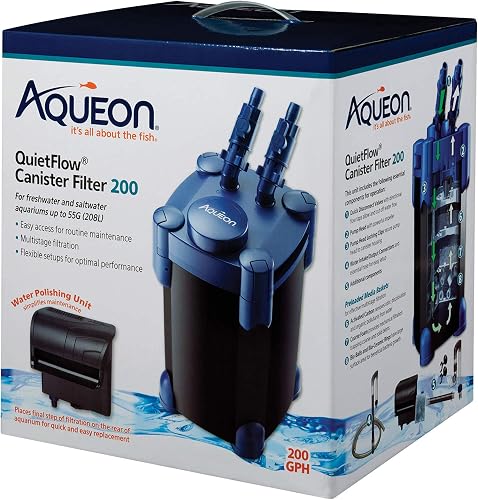
- Most Return Options: Aqueon QuietFlow Canister Filter (up to 55 gallons). The only listing here that advertises multiple return options: a spray bar, a water director, and a hang-on-back polishing unit.
- Only Push-Button Primer: Penn-Plax Cascade 1000 Canister Filter. The only filter here with a push-button primer, per its listing, rated at 265 GPH for tanks up to 100 gallons per Penn-Plax’s catalog.
- Most Compact Canister: EHEIM Classic 250 (2213). 13.9 inches tall per EHEIM’s product page and 4.5 pounds per the listing, the shortest and lightest canister here.
Canister Filter Specs Side by Side
Each figure names its source: the maker’s manual, catalog, or product page, or the Amazon listing. “Not listed” means neither source we read gives a figure. Flow is in gallons per hour (GPH).
| Filter | Rated tank size | Flow | Media layout and start-up |
|---|---|---|---|
| Fluval FX6 (Best Overall) | Up to 400 gal (manual) | 925 GPH pump output; 563 GPH measured without media (manual) | 3 baskets, 1.5 gal of biological media; self-starting pump (manual) |
| Fluval FX4 (Best for Large Tanks up to 250 Gallons) | Up to 250 gal (manual) | 700 GPH pump output; 450 GPH measured without media (manual) | 2 baskets, 1 gal of biological media; self-starting pump (manual) |
| Fluval 407 (Lightest Canister Rated for 100 Gallons) | Up to 100 gal (listing) | 1,450 L/h, about 383 GPH (listing) | EZ-Lift basket stack plus a separate vertical pre-filter; start-up not described on the listing |
| Aqueon QuietFlow, up to 55 gal (Most Return Options) | Up to 55 gal (listing and Aqueon manual) | 200 GPH (Aqueon manual; not on the listing) | 3 baskets: foam, carbon, then ceramic rings and bio-balls; fill with water before start-up (manual) |
| Penn-Plax Cascade 1000 (Only Push-Button Primer) | Up to 100 gal (listing and catalog) | 265 GPH (catalog; the listing’s spec table says “gpm”) | 3 stackable baskets; push-button primer (listing) |
| EHEIM Classic 250 (Most Compact Canister) | 21 to 66 gal (EHEIM manual) | 440 L/h, 116 GPH (manual) | One lift-out filter insert, 3 liters (0.8 gal) of filter volume; started by suction (manual) |
How We Chose
This roundup is based on research, not on running the filters ourselves. We read each Amazon listing in full, opened the maker’s manual, catalog, or product page wherever we could reach it, and read the owner reviews posted on each exact listing. Fluval’s product pages blocked our requests, so the FX figures come from Fluval’s FX series manual and the 407 figures from its listing. Several listings pool reviews across sizes of one line, so the owner notes below use only reviews that name the model or name no size. We weighted rated tank size, media layout, priming after cleaning, the maker’s limits on hoses and height below the tank, and recurring owner complaints. We also check each listing’s voltage field and plug. Where a field shows 220 to 240 volts but Amazon.com sells and ships the product in the US and the title and description show no foreign plug, we treat it as a listing data error, say so, and lower the AquariumTech Score. Where neither the listing nor a US manual gives a voltage, as with the EHEIM, we say so and suggest you check the rating label. Our full method, including how the AquariumTech Score on each card is calculated, is on our How We Review page.
Best Overall went to the canister with the highest average owner rating among makers we approved, with a large body of owner ratings on its own listing; a tie would have gone to the listing with more feedback. Sizes that share ratings within one line stayed in contention with a lowered score, and the EHEIM’s average sits under the bar we set for the label. The label reflects those rules, not a size recommendation: the FX6 is rated well past most home tanks, so check the sizing notes first.
Our Canister Filter Picks in Detail
This roundup is general product information, not repair or electrical safety advice. Follow the safety instructions in your product’s manual, supervise children, and contact the manufacturer or an authorized service center if a product sparks, overheats, or has a damaged cord.
We earn a commission from qualifying purchases made through links on this page. Commissions never affect our rankings or AquariumTech Scores.
Our ranking reflects our overall assessment of specifications, independent reviews, and the AquariumTech Score. The AquariumTech Score itself reflects Amazon customer ratings only.
| Award | Product | AquariumTech Score About AquariumTech ScoreThe AquariumTech Score is our own rating from 0 to 10. It starts from the product's average owner rating and may be adjusted by up to 0.5 points by our editors, using the same published criteria for every product. It is never influenced by manufacturers, retailers, or affiliate commissions. Learn more › | |
|---|---|---|---|
 Fluval FX6 High Performance Canister Filter |
8.6/10 | Buy | |
 Fluval FX4 High Performance Canister Filter |
8.4/10 | Buy | |
 Fluval 407 Performance Canister Filter |
8.0/10 | Buy | |
 Aqueon QuietFlow Canister Filter for Up to 55 Gallons |
8.2/10 | Buy | |
 Penn-Plax Cascade 1000 Canister Filter |
8.1/10 | Buy | |
 EHEIM Classic 250 (2213) Canister Filter |
7.8/10 | Buy |
Fluval FX6 High Performance Canister Filter
An external canister filter rated for aquariums up to 400 gallons, with 925 gallons per hour of pump output and removable, stackable media baskets, per the listing.
Pros
- Holds 1.5 gallons of biological media, per the listing
- Self-starting pump vents trapped air every 12 hours, per the listing
- Utility valve drains the canister for water changes
- 3-year limited warranty, per the listing
Cons
- About 21 inches tall and 19.9 pounds empty, per the listing
- Owners with sand report the long intake can pull in substrate
- Impeller and motor seal are wear parts not covered by the warranty
Fluval FX4 High Performance Canister Filter
An external canister filter rated for aquariums up to 250 gallons, with 700 gallons per hour of pump output and 1 gallon of media in stackable baskets, per the listing.
Pros
- Self-starting pump vents trapped air every 12 hours, per the listing
- Removable baskets lined with foam inserts
- Listed at 16.5 inches tall to fit under most aquariums
- 3-year limited warranty, per the listing
Cons
- Listing shows conflicting height figures, so measure with margin
- 14.17 pounds empty, per the listing
- Impeller and motor seal are wear parts not covered by the warranty
Fluval 407 Performance Canister Filter
An external canister filter rated for aquariums up to 100 gallons, with a listed flow of 1,450 liters per hour, an eTEC pump, and EZ-Lift media baskets, per the listing.
Pros
- eTEC pump described as using about the energy of an LED bulb
- Media stack lifts out with a center handle, per the listing
- Separate vertical pre-filter for mechanical filtration
- Several Fluval media types listed as included
Cons
- Listing shows two different sets of dimensions
- Listing shows 230 volts, so check the rating label
- Ratings appear to be shared with other 07 series sizes
Aqueon QuietFlow Canister Filter for Up to 55 Gallons
A canister filter for aquariums up to 55 gallons that ships with coarse foam, activated carbon, bio-balls, and bio-ceramic rings, plus a spray bar, a water director, and a hang-on-back polishing unit, per the listing.
Pros
- Three return options: spray bar, water director, or polishing unit
- Starter media for all three filtration stages included, per the listing
- Quick disconnect valves and hoses included
Cons
- Listing gives no flow rate
- Polishing unit uses Large Aqueon cartridges, replaced monthly per the listing
- Some owners report trouble priming or restarting after cleaning
Penn-Plax Cascade 1000 Canister Filter
A canister filter rated at 265 GPH for aquariums up to 100 gallons, with three stackable media baskets, a push-button primer, and two rotating valve taps, per the listing.
Pros
- Three large stackable media baskets, per the listing
- Ships with floss pads, a bio-sponge, carbon, and a spray bar
- Valve taps for flow control and hose disconnection
- Flow and tank rating match the Penn-Plax catalog
Cons
- Owners report slow or stubborn first priming
- Listing shows the flow rate in the wrong unit
- Ratings appear shared with other Cascade sizes
- Some owners hear it in a quiet room
EHEIM Classic 250 (2213) Canister Filter
A canister filter that ships with EHEIM Mech and Substrat Pro media, valves, a spray bar, an inlet pipe, and hose, per the listing. The listing does not give a flow rate or tank size.
Pros
- Spray bar, valves, and starter media included
- Two-year warranty, per the listing
- Owners describe it as quiet
Cons
- No flow rate or tank size in the listing
- Manual priming by suction, and one owner found the instructions hard to use
- One owner reports air being drawn in at a lower fitting
1. Fluval FX6 High Performance Canister Filter: Best Overall
Who it’s for: keepers of tanks above 250 gallons, or of a heavily stocked large tank, who have cabinet floor space for a tall, heavy canister.
Highlights: Per Fluval’s FX series user manual, the FX6 is rated for aquariums up to 400 gallons and holds 1.5 gallons of biological media inside 5.28 gallons of filtration volume, spread over three baskets, with 10.8 feet of head height, the most in the FX range. The pump primes itself once the canister is filled and pauses every 12 hours to vent trapped air. A utility valve at the base drains the canister before service. The listing matches the 400 gallon, 925 GPH, and 1.5 gallon figures, but its “Maximum Lifting Height” field reads 21 inches against the manual’s 10.8 feet, so we lowered its AquariumTech Score by an editorial adjustment, as described on our How We Review page. Our Fluval FX6 review covers sizing and the full maintenance chart.
It takes Best Overall under the rules in How We Chose. For a tank within the 100-gallon rating of the 407 or the Cascade 1000, it is more filter than you need.
Pros
- Starts and vents air without a hand primer, per the manual.
- Built-in drain valve for emptying the canister and for water changes.
Cons
- About 21 inches tall per the listing’s description and 19.9 pounds per the listing.
- The manual schedules a new impeller and motor seal ring every year, and the warranty excludes both parts.
What owners say: Most reviews come from turtle keepers and owners of large fish on tanks of 75 to 125 gallons. One owner sets the canister in a shallow plastic storage tub so spills during service stay off the cabinet floor. Another warns that the intake tube can be lengthened but not shortened, so on a sand-bottom tank it can reach the substrate and pull sand in. On the negative side, one owner’s motor began pulsing and failing within seven months, and that owner found Fluval’s support hours hard to reach.
Who should look elsewhere: owners of tanks that fit within the 100-gallon rating of the 407 or the Cascade 1000, anyone whose cabinet cannot clear about 21 inches plus room to lift the lid, and sand-bottom tanks where you would rather not add a pre-filter or reposition the intake.
2. Fluval FX4 High Performance Canister Filter: Best for Large Tanks up to 250 Gallons
Who it’s for: tanks of roughly 100 to 250 gallons, or a heavily stocked mid-size tank, where cabinet height rules out the FX6.
Highlights: Fluval’s FX manual rates the FX4 for up to 250 gallons, the largest rating below the FX6, with 700 GPH of pump output, 450 GPH measured through the canister without media, 1 gallon of biological media in two baskets, and 30 W at 120 V. It shares the FX6’s self-starting pump, drain valve, and hose limits, but its head height drops to 6.9 feet. According to the Amazon listing, each basket is lined with a foam insert and T-handles lift the stack out. The listing puts it at 16.5 inches tall (other listing fields say 15.6 and 17.7), so measure your cabinet against the tallest figure. The FX2, FX4, and FX6 appear to share one Amazon listing and its owner ratings, so we lowered its AquariumTech Score by an editorial adjustment, as described on our How We Review page. Our Fluval FX4 review goes through the media set and maintenance chart.
Pros
- Same self-starting design as the FX6 in a shorter canister, per the listing.
- Draws 30 W against the FX6’s 43 W at 120 V, per the manual.
Cons
- Listing height figures conflict.
- Two baskets instead of three, so less room for a custom media order.
Who should look elsewhere: tanks over 250 gallons (the FX6 covers those), setups where the canister must sit far below a tall tank (the FX6’s 10.8 feet of head height gives more margin), and tanks that fit within the 100-gallon rating of the 407 or the Cascade 1000.
3. Fluval 407 Performance Canister Filter: Lightest Canister Rated for 100 Gallons
Who it’s for: a tank within its 100 gallon rating, where a lighter canister and quick access to the media matter.
Highlights: According to the Amazon listing, the 407 is rated for aquariums up to 100 gallons at 1,450 liters per hour (about 383 GPH) and weighs 9.7 pounds. The EZ-Lift media stack comes out by a center handle without emptying the canister, and a vertical pre-filter cartridge has its own access, a separate pre-filter stage. We could not open Fluval’s 07 series pages, so every figure here is per the listing. The listing’s voltage field shows 230 V, which conflicts with Amazon.com selling it in the US; check the rating label before plugging it in. The listing also gives two sets of dimensions. Our Fluval 407 review covers those listing issues. Its ratings appear to be shared with the 107, 207, and 307 sizes, and its voltage field conflicts with its US sale, so we lowered its AquariumTech Score by an editorial adjustment, as described on our How We Review page.
Pros
- Lighter than the other 100-gallon canister here, per their listings.
- Separate pre-filter you can reach without lifting the main stack, per the listing.
Cons
- The listing’s voltage field and dimensions need confirming before use.
- One owner reports repeated motor head failures on the 407.
What owners say: Owners mostly describe clear water and very little noise; one runs it on a 55 gallon tank and likes the strong current. A reviewer with a 29 gallon planted tank, who did not name a size, added a spray bar because the standard nozzle pushed floating plants around. The serious complaint comes from a long-time Fluval user who replaced the 407’s motor head several times and traced the fault to an impeller cover that would not stay engaged under water pressure.
Who should look elsewhere: tanks over 100 gallons (the FX4 is the step up), buyers who need a confirmed 120-volt rating before ordering, and anyone who wants owner ratings that describe one exact size.
4. Aqueon QuietFlow Canister Filter (Up to 55 Gallons): Most Return Options
Who it’s for: a freshwater or saltwater tank of up to 55 gallons where you want to choose between surface movement, a directed jet, or an extra stage of mechanical polishing.
Highlights: The listing advertises multiple return options in the box: a spray bar for surface movement, a water director, and a polishing unit that hangs on the rim and holds a Large Aqueon cartridge, along with coarse foam, carbon, bio-balls, and ceramic rings. In Aqueon’s QuietFlow canister instructions, the 200G version, sold for tanks up to 55 gallons, runs 200 GPH on 120 V, and its media goes foam over carbon over rings and balls in three baskets. You prime it by pouring water into the polishing unit or through the vent cap, and closing the quick disconnect valves before service keeps the inlet line full. Aqueon’s QuietFlow canister page gives a one-year warranty and fresh or saltwater use. The listing prints no flow rate and a model number that differs from the manual’s, so compare the box on arrival. Its ratings appear to be shared with a larger QuietFlow size, so we lowered its AquariumTech Score by an editorial adjustment, as described on our How We Review page.
Pros
- Three return fittings and starter media for every stage.
- Closed valves keep the inlet line full between cleanings, per the manual.
Cons
- No flow rate on the listing.
- The manual says to replace a polishing cartridge that is more than 3 weeks old or cannot be cleaned.
What owners say: One owner stresses matching the IN and OUT markings when attaching the tubing and filling the canister with water before the first start. Another uses the space below the bottom basket for an extra layer of ceramic rings or bio-balls, so debris collects there first. A turtle keeper who runs the tank three-quarters full found the falling return water loud through the spray bar and moved to the polishing unit instead. One reviewer gave up on theirs within the first year because it refused to start again after a cleaning.
Who should look elsewhere: tanks over 55 gallons, anyone who wants a flow figure printed on the listing, and anyone who wants a canister that primes itself once filled with water (the FX models do, per Fluval’s manual).
5. Penn-Plax Cascade 1000 Canister Filter: Only Push-Button Primer
Who it’s for: a tank within its 100 gallon rating where you want three large baskets to fill your own way.
Highlights: Penn-Plax’s aquarium equipment catalog lists the Cascade 1000 (CCF3UL) at 265 GPH for aquariums up to 100 gallons, matching the listing title; the listing’s spec table prints the flow as “265 gpm,” a unit error. According to the Amazon listing, the filter is meant for freshwater, saltwater, and turtle habitats, and it comes with three stackable baskets with handles, a push-button primer, two rotating valve taps, floss pads, a coarse bio-sponge, a carbon bag, and a spray bar. Its warranty field says only “Amazon Policy.” Our Penn-Plax Cascade review covers the other sizes. Its ratings appear to be shared with other Cascade sizes, so we lowered its AquariumTech Score by an editorial adjustment, as described on our How We Review page.
Pros
- Flow and tank rating confirmed by the maker’s catalog.
- Three baskets and a full starter kit, per the listing.
Cons
- Owners report that the first priming can take persistence.
- No maker warranty stated on the listing.
What owners say: A first-time canister owner with a turtle in a 75 gallon tank learned to pump the primer quickly and keeps the canister in a plastic crate; after the first media change, the full hoses restarted it without priming. Another turtle keeper needed about two minutes of pumping before the air cleared, then found it silent. A goldfish keeper reports years of use with one inexpensive part replaced, though a replacement impeller O-ring was hard to find. A reviewer who did not name a size could hear it across a quiet room.
Who should look elsewhere: tanks well under its 100-gallon rating (Penn-Plax’s catalog lists smaller Cascade sizes), cabinets shorter than about 17 inches inside, anyone who would rather not work a hand primer, and buyers who want a stated maker warranty.
6. EHEIM Classic 250 (2213) Canister Filter: Most Compact Canister
Who it’s for: a tank within its 21 to 66 gallon rating where cabinet space is tight and a manual first start is acceptable.
Highlights: EHEIM’s classic 250 operating manual rates it for 80 to 250 liters (21 to 66 US gallons) at 440 liters per hour (116 GPH), with 3 liters of filter volume in a single filter insert that lifts out by its handle. Per EHEIM’s product page, the canister measures 6.3 inches across and 13.9 inches tall, the shortest here, and its listed 4.5 pounds is the lightest. EHEIM’s classic 250 product page is the UK page: it lists a two-year guarantee, but we could not confirm those terms for this US listing, and its electrical figures are not given here. We also could not confirm a 120 volt rating for this US listing, which prints no voltage. The Amazon listing itself has errors: its description names the type number of the smaller classic 150 and a stand that EHEIM lists only for that model, and it gives no flow rate or tank size. The listing appears to share its owner ratings with other sizes of the same filter (it offers 40, 66, and 92 US gallon versions), so we lowered its AquariumTech Score by an editorial adjustment, as described on our How We Review page. Our EHEIM Classic review covers the larger classic sizes.
Pros
- Shortest and lightest canister here (EHEIM product page, listing).
- Valves, spray bar, and starter media included, per the listing.
Cons
- Started by suction on the outlet elbow, per the manual.
- One owner found the printed instructions hard to follow.
What owners say: Only one reviewer names the 250. That owner moved seeded media over from an older EHEIM, likes that water enters at the bottom and leaves at the top, and needed extra hose for a standard 55 gallon tank. A reviewer with a 55 gallon turtle tank, who did not name a model, found it nearly silent in the cabinet but had to cut the tubing to fit the valves. A reviewer who describes the filter basket but not the model reports air drawn in at the lower fitting, with loud noise.
Who should look elsewhere: tanks over about 66 gallons, anyone who wants a self-starting pump or a primer button, and anyone who wants detailed printed instructions.
How to Choose a Canister Filter: Size, Baskets, Priming, and Placement
Match the rated tank size, then allow for stocking
Pick a model whose range covers your tank, and for a heavily stocked tank, pick one rated well above your volume; owners quoted above run 75 gallon tanks on the 100-gallon Cascade and the 400-gallon FX6. As a rough guide from these ratings, a 21 to 55 gallon tank fits the EHEIM Classic 250 or the Aqueon, a 55 to 100 gallon tank fits the 407 or the Cascade 1000, 100 to 250 gallons is FX4 territory, and anything larger points to the FX6. Narrower shortlists, such as canister filters for 55 gallon tanks, canister filters for 75 gallon tanks, or small canister filters for nano setups, sort the field further. Below about 20 gallons, our picks of hang-on-back filters are usually the simpler route.
Treat flow figures as an upper limit. Fluval’s manual is the only source here that separates pump output from circulation measured through the canister, and it notes that the measurement used equal-length hoses and no media. Packed baskets and long hose runs pull real flow below both numbers.
Count the baskets and plan the media order
Basket layout decides how you sort mechanical, chemical, and biological media, and how much you disturb when you service one stage. Fluval’s manual says loose granular media such as carbon or ammonia remover belongs in a media bag in the bottom basket, so particles cannot reach the impeller, and that each basket needs at least 0.5 inch of free space at the top so the stack seats properly. EHEIM’s manual says the carbon fleece is for the start-up of a new aquarium and should come out after a running-in period of about 2 to 4 weeks. For choosing filter media to fill the baskets, see our separate roundup.
Pick a priming method you will repeat
A canister must be full of water and free of air before the pump can move water, and you repeat some form of that after every cleaning. The four methods here:
- Self-starting (FX4, FX6): pour in 1.6 or 2 gallons, close the lid, and plug in; per the manual, the pump runs for a minute, stops for two minutes to release air, then runs continuously.
- Push-button primer (Cascade 1000): the listing describes a hand primer; owners say quick, repeated pushes, a full tank, and hoses that run straight downhill help most.
- Pour-in (Aqueon): water goes in through the polishing unit or the vent cap, and the manual says to unplug and vent trapped air if no water flows.
- Suction (EHEIM): per the manual, you apply suction at the end of the outlet elbow until the filter fills on its own, reconnect it, and only then plug in.
The 407 listing does not describe its start-up, so follow its manual. With any method, closing both valves before you disconnect the canister keeps the hoses full and saves a full re-prime, as the Aqueon manual and owners of the FX6, Cascade, and EHEIM note.
Plan hoses, height, and cabinet space
Canisters are gravity-fed, so the makers set limits on where they sit relative to the water. Measure the cabinet’s inside height and the drop from the water surface before you order.
| Filter | Height | Weight, empty | Placement limits |
|---|---|---|---|
| Fluval FX6 | About 21 in (listing) | 19.9 lb (listing) | Never above the water level; supplied hose 13.1 ft; intake hose no longer than 6.5 ft and both hoses no more than 16.4 ft combined; 10.8 ft head height (manual) |
| Fluval FX4 | 16.5 in (listing; other fields show 15.6 and 17.7 in) | 14.17 lb (listing) | Same hose limits as the FX6; 6.9 ft head height (manual) |
| Fluval 407 | Not confirmed (listing gives 14.5 in and 19.29 in) | 9.7 lb (listing) | Not listed |
| Aqueon QuietFlow, up to 55 gal | Not confirmed (listing and Aqueon page differ) | 14.55 lb (listing) | No more than 4.5 ft below the tank’s water level; water line no more than 8 in below the frame (manual) |
| Penn-Plax Cascade 1000 | 17 in (listing) | 12 lb (listing) | Not listed |
| EHEIM Classic 250 | 13.9 in, 6.3 in across (product page) | 4.5 lb (listing) | Pump head at least 10 cm (about 4 in) below the water level; no more than 180 cm (about 5.9 ft) from the water surface to the bottom of the filter (manual) |
Hose routing matters as much as length. Fluval’s manual asks for a straight path from the filter to the rim with no slack and no loops, EHEIM’s says to keep runs as short as possible to avoid loops and kinks, and Aqueon’s says the hosing should have no twists or major bends. Aqueon’s troubleshooting section adds that if the top of the tank sits more than 6 feet above the top of the canister, water can leak past the lid seal when the motor is off.
Keep to a maintenance rhythm
Fluval’s FX chart sets a monthly carbon pad change and BIOMAX rinse, impeller checks every 3 months, and a new impeller and motor seal ring every year, with silicone lubricant only and no soap; Aqueon’s page calls for fresh carbon every 30 days, and EHEIM’s manual has you rinse the mats and check the sealing ring at each cleaning. Follow the intervals in your own model’s manual rather than a general rule.
Electrical safety under the tank
A canister puts a powered pump next to several gallons of water, usually inside a closed cabinet. The Fluval, Aqueon, and EHEIM manuals all call for a drip loop in the power cord and for unplugging every aquarium appliance before your hands go in the water or before servicing; Fluval and Aqueon add that a unit with abnormal leakage should be unplugged, and EHEIM recommends a residual current device and asking an electrician about it. Check the rating label against your outlet before the first start, especially where a listing’s voltage field conflicts with its US sale, as the 407’s does, or gives no voltage, as the EHEIM’s does. If a unit leaks, hums unusually, or feels hot, unplug it, stop using it, and contact the maker or seller rather than attempting a repair; if your fish behave abnormally after a filter failure, contact a licensed aquatic veterinarian.
Other designs, including hang-on-back, internal, and sponge filters, are in our filters section.
Frequently Asked Questions
How do you set up a canister filter for an aquarium?
Follow your model’s manual; the broad order is the same across these makers. Place the canister below the water level within the maker’s height limits, rinse the media, and load the baskets in the order shown. Mount the intake and return, cut the hoses for a straight run (Fluval’s manual says to leave at least 6 inches beyond the rim, since you can trim more later), and connect the IN and OUT ports. Fill or prime the canister by your model’s method, plug it in only once it is full, with a drip loop in the cord, and watch every connection for drips during the first hour.
How do you clean an aquarium canister filter, such as a Cascade?
Close both valves, unplug the filter, disconnect the hoses, and open the canister over a sink or tray, since some water escapes as it depressurizes. Rinse foam and biological media in tank water or as the manual directs, replace chemical media such as carbon, and check the lid seal before refilling and restarting; Cascade owners rinse the sponge and carbon bag in the water left in the canister. The same order applies to other brands, including Marineland canisters, but the intervals come from each model’s manual, and our guide to cleaning an aquarium filter covers other filter types.
Why is my canister filter noisy or not pumping water?
Owners of several of these filters describe trapped air after a cleaning, and it should clear once the canister is full. Aqueon’s troubleshooting list checks that both valves are open, the holes in the stacked baskets line up, every tubing connection is tight, and the air has been purged. A low water level can also make the return splash loudly, as one Aqueon owner found. If the filter still will not move water, or it leaks, unplug it and contact the maker or seller.
Can canister filters run on saltwater tanks?
Five of the six can, per their makers or listings. Fluval’s FX manual says the filters may be used with fresh or salt water, Aqueon’s page says the QuietFlow canisters suit both, EHEIM’s UK product page marks the classic 250 for sea water, and the Cascade 1000 listing names saltwater tanks. The 407 listing does not say, so check its manual before using it on a marine tank.
Which Fluval canister filter should I choose?
Go by tank size first. Per Fluval’s manual, the FX6 is rated for up to 400 gallons and the FX4 for up to 250, and both use a self-starting pump and a drain valve at the base. Choose the FX4 when your tank sits between about 100 and 250 gallons or your cabinet cannot clear the FX6’s height, and the FX6 when the tank is larger or the canister has to sit far below the water line. For smaller tanks, the 07 series steps down by listing title: the 407 is listed for up to 100 gallons, the Fluval 307 canister filter for up to 70, and the Fluval 207 for up to 45. Each of the three 07 series listings shows a voltage field of 220 to 240 volts that conflicts with Amazon.com selling it in the US, so check the rating label before the first start.
About the author
Soham James is a fishkeeping enthusiast with a keen interest in aquarium technology and equipment selection. At AquariumTechLab.com, Soham explains filters, heaters, pumps, and monitoring tools, helping aquarists understand their options and choose equipment suited to their tanks.