
Penn-Plax Cascade Canister Filter Review
Our Penn-Plax Cascade review covers the Cascade 1000 canister filter: 265 GPH flow, 100-gallon rating, media, priming, owner feedback, and size options.
 Updated October 24, 2026

The Penn-Plax Cascade is Penn-Plax’s canister filter line, and this review covers the Cascade 1000: a 265 gallon-per-hour canister rated for aquariums up to 100 gallons, according to both the Amazon listing and Penn-Plax’s own catalog. It suits keepers of messy fish or turtles in tanks of roughly 40 to 100 gallons who want room for their own media, such as the 40-gallon goldfish tank and the 75-gallon turtle tank two owners run it on. It is a weaker fit if you need a near-silent filter in a quiet room on day one, or if you would rather not fight with a manual primer.
We did not run this filter ourselves. This review draws on the full Amazon listing for the Cascade 1000 (model CCF3UL), the owner reviews posted on it, and Penn-Plax’s aquarium equipment catalog, which lists every Cascade canister size with its flow rate and tank rating. Figures marked “per the listing” come from Amazon; figures marked “per the catalog” come from that Penn-Plax document.
This review is general product information, not repair or electrical safety advice. Follow the safety instructions in your product’s manual, supervise children, and contact the manufacturer or an authorized service center if a product sparks, overheats, or has a damaged cord.

We earn a commission from qualifying purchases made through links on this page. Commissions never affect our rankings or AquariumTech Scores.
Penn-Plax Cascade 1000 Canister Filter





As an Amazon Associate we earn from qualifying purchases.
Shared ratings: this listing’s ratings match the listings for the Cascade 700, 1200, and 1500 exactly, so they appear to be pooled across several sizes of the line, and some reviews on it describe the 1200 or the 1500. We lowered this product’s AquariumTech Score slightly for that reason. In the owner section below, we only drew on reviews that name the Cascade 1000 (or its CCF3UL model number) or do not name a size.
Who the Penn-Plax Cascade 1000 Suits
- Tanks of about 40 to 100 gallons: the listing and catalog both rate it for aquariums up to 100 gallons, and owners on this listing run it on 40-, 55-, 65-, 75-, and 120-gallon tanks (the last one alongside a hang-on-back filter as backup).
- Turtle and goldfish keepers: the listing names turtle habitats along with freshwater and saltwater tanks, and three of the owners we drew on keep turtles or goldfish, messy animals that two of them say their old hang-on-back filters could not keep up with.
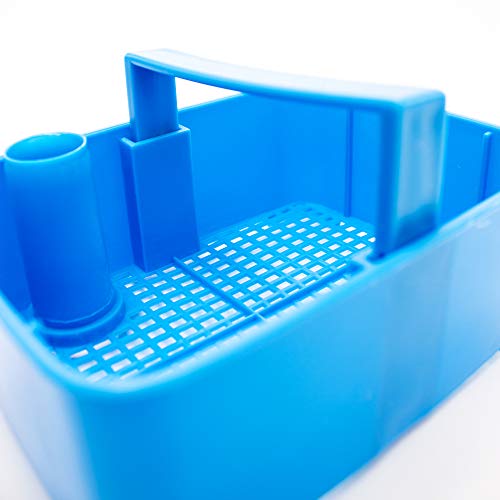
- Owners who like to choose their own media: the listing describes three large stackable baskets with handles, and owners fill them with floss, sponge, carbon, ceramic rings, or hand-cut pads.
- Setups with space under or beside the tank: the canister measures about 11.5 x 10 x 17 inches (W x D x H) per the listing, so check your cabinet height before ordering.
Cascade 1000 at a Glance
| Spec | Cascade 1000 | Source |
|---|---|---|
| Model number | CCF3UL | Listing and catalog |
| Flow rate | 265 gallons per hour | Listing title and catalog |
| Rated aquarium size | Up to 100 gallons (379 L) | Listing and catalog |
| Media baskets | 3 stackable baskets with handles | Listing |
| Included media | 3 poly fiber floss pads, 1 coarse bio-sponge, 1 activated carbon bag | Listing |
| Other parts | Spray bar, hose clamps, alignment clamps, base, two 360-degree valve taps, push-button primer | Listing |
| Dimensions | 11.5 x 10 x 17 in (W x D x H) | Listing |
| Weight | 12 pounds | Listing |
| Power | 110V, 60Hz, 28.5W | Listing |
| Water type | Freshwater, saltwater, turtle habitats | Listing |
Three Listing Details to Check
Flow rate unit: the listing’s specification table gives the maximum flow as “265 gpm,” while the title and feature bullets say 265 GPH. Penn-Plax’s catalog lists the Cascade 1000 at 265 GPH, so the gallons-per-minute figure is a unit error in the listing. Read every flow figure on this page as gallons per hour.
Warranty: the listing’s warranty field reads only “Amazon Policy,” and it does not state a maker warranty. Check the paperwork in the box and keep your receipt.
Which size you are buying: because the ratings are shared across sizes, check that the title reads 265 GPH and 100 gallons. The model number for this size is CCF3UL in both the listing and the catalog, and the title should read 265 GPH and 100 gallons.
What We Like
- Room for custom media: three large baskets, per the listing, give you space for mechanical, chemical, and biological stages. One owner runs floss in every basket with a bio-sponge, a carbon bag, and ceramic rings on top; another cuts cheap pads by hand to keep media costs down.
- Complete kit: according to the Amazon listing, the box includes floss pads, a coarse bio-sponge, a carbon bag, a spray bar, and the clamps, so you can run it the day it arrives.
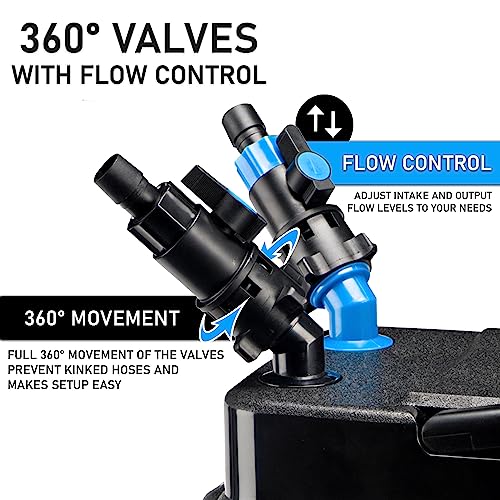
- Valves on the hoses: the listing describes two 360-degree rotating valve taps for flow control and for disconnecting the canister during cleaning, which helps in a cramped cabinet.
- See-through housing: one long-term owner likes that the blue housing is transparent, so you can see the water and media inside without opening it.
- Long service life for some owners: one goldfish keeper reports more than a decade of use with a single inexpensive part replaced, and a turtle keeper reports more than three years of daily running.
What Could Be Better
- Priming can be stubborn: one owner needed about two minutes of pumping before it ran without air bubbles, another found one of three units hard to prime, and a third says you have to push the primer button very fast.
- Not silent for everyone: most owners we drew on call it quiet once full, but one says it can be heard across the room when nothing else is on.
- One unit arrived faulty: one owner returned one of three units for a rattling impeller that did not pump water; the exchange unit worked. The same owner notes the impeller shaft is plastic, not stainless steel.
- Basic instructions and hard-to-find seals: a long-term owner found the instructions too thin on gaskets and small parts, and had trouble finding a replacement impeller O-ring.
- Messy to open: per one owner, some water comes out as the canister depressurizes, so open it in a sink or over a wide tray.
What Owners Say
The clearest account comes from a first-time canister user with one turtle in a 75-gallon tank holding about 60 gallons of water. The water improved noticeably within 24 hours and took about a week to clear, using only the included media. The first set of media lasted about three weeks before the water clouded again; after that, the owner went five weeks between changes with clear water and still reported clear water after more than three years. This owner rinses the carbon bag and bio-sponge in the water left in the canister, stuffs extra floss around the top basket, and keeps the canister in a plastic crate in case of spills.
A goldfish keeper with a 40-gallon tank moved to the Cascade 1000 from a hang-on-back filter that had become too loud for a bedroom, and describes it as quiet years later. The only leak that owner reports came from reassembling the hose connectors incorrectly after a media change. A red-eared slider owner says the water stayed clear for two weeks with only the stock media, compared with cloudy water within two days on the old filter, and that the filter runs silently once primed.
Another owner saw cloudy water for the first couple of days, which they put down to cheap ceramic rings they had added, then clear water after that. On bypass, the same owner says a small amount of water slips around the trays, and that seating each tray properly and not overfilling any of them keeps the gaps small. An owner who bought three units for 55-, 65-, and 120-gallon tanks found setup fairly easy and spare parts available online.
If a unit leaks or stops pumping, unplug it, stop using it, and contact the seller or Penn-Plax rather than attempting a repair.
How to Set Up a Penn-Plax Cascade Canister Filter
We could not find a Cascade instruction manual on Penn-Plax’s website, so follow the instructions and safety notes in the box first, including when it is safe to plug the canister in. Owners on this listing add these practical points:
- Measure before you cut the hoses: one owner cut the hoses to about 40 inches for a canister sitting directly under the tank, with the hoses hung off the back next to the wall.
- Open both valves before priming: one owner’s tips are to keep both valves open so air can escape, keep the tank full so the primer does not have to lift water far, and route both hoses in a steady downhill line with no dips.
- Pump the primer quickly: owners report anywhere from about five pushes to two minutes of pumping. Expect noise and bubbles while the air clears.
- Use the spray bar for gentle flow: the listing includes a spray bar for surface movement, and one owner used three of its four tube sections to carry the return farther into the tank.
- Secure the intake in turtle tanks: the suction cups held the return tubes for one owner but could not keep a turtle from pulling the intake tube out of its holders.
Cleaning and Replacement Media
Unplug the filter and use the valve taps to shut off the flow before you disconnect the hoses, then open the canister in a sink or over a tray. The turtle owner above rinses the carbon bag and sponge in the water left in the canister; an owner with three units reuses the same media over several cleanings and changes only the carbon each time. Two owners report that after the first cleaning they did not need to prime again, because the hoses stayed full once reconnected and the valves were opened.
Penn-Plax’s catalog lists replacement Bio-Sponges (CCF229) and Bio-Floss pads (CCF231, six per package) that fit the Cascade 700 and 1000. Its Cascade and Marlin Filt-A-Pack media in mesh bags include Pro-Carb activated carbon, Pro-Z zeolite, and a carbon and zeolite blend, and it also lists ceramic filter rings. For bio media options beyond Penn-Plax’s own, owners on this listing run third-party ceramic rings and hand-cut pads in the baskets. The catalog also lists the Cascade Optimizer, a pre-filter that connects to an existing canister to catch large debris before it reaches the baskets.
Penn-Plax Cascade Sizes: 500, 700, 1000, 1200, and 1500
Penn-Plax’s catalog lists five standard Cascade canisters. Here is how they line up:
| Model | Flow rate | Rated tank size |
|---|---|---|
| Cascade 500 (CCF1UL) | 115 GPH | Up to 30 gallons |
| Cascade 700 (CCF2UL) | 185 GPH | Up to 65 gallons |
| Cascade 1000 (CCF3UL) | 265 GPH | Up to 100 gallons |
| Cascade 1200 (CCF4UL) | 315 GPH | Up to 150 gallons |
| Cascade 1500 (CCF5UL) | 350 GPH | Up to 200 gallons |
Source: Penn-Plax catalog. The catalog also lists a larger Cascade Max-Flow canister at 820 GPH for tanks of 150 gallons and up. For a 55-gallon tank, the Penn-Plax Cascade 700 sits close to its 65-gallon ceiling, so the 1000 gives more headroom; for messy fish or turtles in a 75-gallon tank, the 1000 is rated well above the volume. The Penn-Plax Cascade 1500 and the 1200 cover tanks over 100 gallons. Because these listings share ratings, read each listing title for the flow rate and model number before you buy.
How It Compares
Cascade 1000 vs a hang-on-back filter: several owners on this listing came from hang-on-back filters. A goldfish keeper says the old one needed constant media replacement and grew louder over time, and a turtle keeper says the water clouded within a week on it. The trade-off is setup: hoses, valves, priming, and a canister to carry to the sink.
Cascade 1000 vs the Fluval 407: both are rated for tanks up to 100 gallons per their listing titles. Some owners on this listing say they picked the Cascade over pricier canisters; if you are weighing the two, compare the media layout and priming method on each listing. The 407 listing’s voltage field shows 230 V, which conflicts with Amazon.com selling it in the US; check the rating label. Our aquarium filter section covers other canister filters as well as hang-on-back and sponge options.
Who Should Look Elsewhere
- Owners of tanks under 30 gallons: the catalog rates the Cascade 500 for tanks up to 30 gallons, which is a closer match, as is a hang-on-back filter.
- Anyone who needs silence in a quiet room right away: one owner could hear it across the room, and the priming process is noisy.
- Shoppers who want a stated maker warranty on the listing: the warranty field says only “Amazon Policy.”
- Short cabinets: at about 17 inches tall per the listing, it did not fit under one owner’s tank.
- Keepers who want a filter for a turtle tank with no extra work: owners make it work, but they add crates, extra floss, or a second filter to manage the mess.
Why You Should Trust Us
We do not conduct our own product trials; our reviews draw on published specifications, manufacturer documents, and owner reviews on the listing, and Amazon owner ratings also set each product’s AquariumTech Score. For this review, that meant one listing, the owner reviews that describe this size, and Penn-Plax’s catalog, each cited where used. Commissions on purchases through our links do not influence the score or the verdict; see How We Review for the method.
Final Verdict
The Penn-Plax Cascade 1000 is a practical canister filter for tanks of about 40 to 100 gallons, especially for goldfish and turtles, if you want large baskets you can fill your own way. Its 265 GPH flow and 100-gallon rating are confirmed by Penn-Plax’s catalog. Expect some effort at the first prime, plan to open it over a sink, and check the listing title carefully, since the listings for different sizes share their ratings.
Frequently Asked Questions
How do you clean a Cascade canister filter?
Unplug it, close both valves, disconnect the hoses, and carry the canister to a sink or tray before opening it. Rinse the sponge and reusable media, as owners on this listing do in water from the canister, and reassemble the hose connectors exactly as they came apart; one owner’s only leak came from getting that step wrong.
How do you set up and prime a Penn-Plax Cascade canister filter?
Follow the instructions in the box, then fill the tank, open both valves, and pump the push-button primer quickly until water reaches the canister and the air clears. Owners say straight, downhill hose runs and a full tank make priming much easier.
Should I get the Cascade 700 or the Cascade 1000?
Per Penn-Plax’s catalog, the 700 runs 185 GPH for tanks up to 65 gallons and the 1000 runs 265 GPH for tanks up to 100 gallons. For tanks near 55 gallons or with messy fish, the 1000 gives more headroom; the two share the same replacement sponge and floss pads.
Is the Cascade 1000 good for a turtle tank?
The listing names turtle habitats, and two turtle owners on this listing report clear water after switching to it. Plan for heavier upkeep and secure the intake tube, since one turtle pulled it out of its holders.
Is the Penn-Plax Cascade 1000 quiet?
Most owners we drew on describe it as quiet or silent once the air is out, though the spray bar’s falling water makes noise. One owner could hear it across a quiet room.
About the author
Soham James is a fishkeeping enthusiast with a keen interest in aquarium technology and equipment selection. At AquariumTechLab.com, Soham explains filters, heaters, pumps, and monitoring tools, helping aquarists understand their options and choose equipment suited to their tanks.